
Understanding Business Intelligence and Data Warehousing

Introduction
In our modern world, businesses generate vast amounts of data, but data alone doesn’t drive value. What matters is how effectively organizations can interpret and apply that data. Business intelligence (BI) helps uncover actionable insights through analysis and visualization, while data warehousing provides a central location for storing structured, clean data. In this blog, we’ll explore what each term means, how these concepts complement each other, and practical strategies for successful implementation.
What is business intelligence and data warehousing?
Business Intelligence refers to the use of software tools to analyze data and present it in visual formats like dashboards, charts, and reports. The insights gained from BI software support data-driven decisions, improve visibility into operations, and enable forecasting and trend analysis.
Data warehousing is the process of aggregating data from different systems into a centralized repository. It ensures consistency, structure, and accessibility across historical and real-time data sources, providing the foundation on which BI tools operate.
How can you benefit from integrating data warehousing with business intelligence?
Combining these tools helps you use your data more effectively. The benefits include:
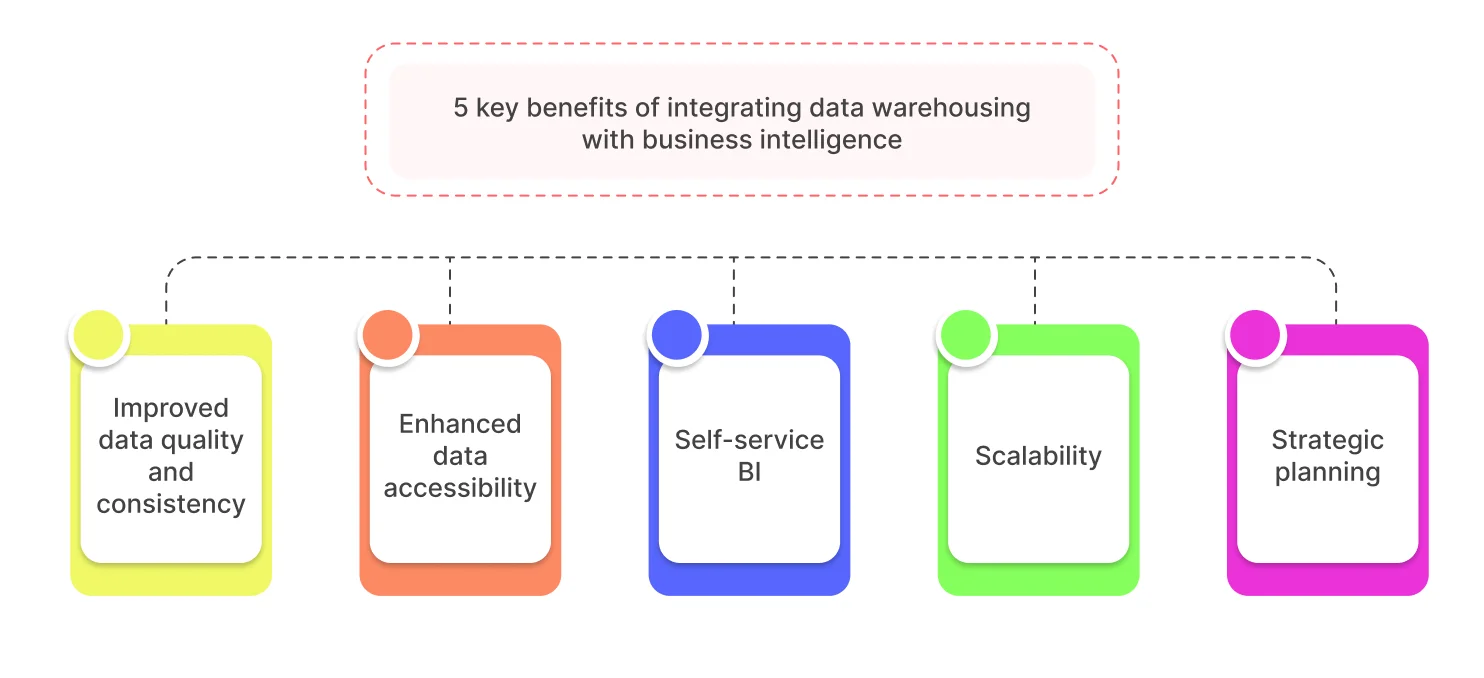
Improved data quality and consistency
Centralized storage ensures that everyone is working from the same, clean data set, reducing discrepancies across reports.
Enhanced data accessibility
With a data warehouse backing your BI tools, decision-makers can access and explore data independently and in real-time.
Self-service BI
Integration empowers non-technical users to generate their own insights, reducing reliance on data analysts and speeding up operations.
Scalability
As your business grows, a scalable data infrastructure ensures that increasing volumes of data can still be analyzed efficiently.
Strategic planning
Historical and real-time data combined help teams recognize patterns, optimize processes, and plan with confidence.
Now that we’ve explored the benefits of implementing BI tools and data warehousing, let’s see how they complement each other.
How business intelligence and data warehousing work together in business
While BI tools and data warehousing serve different functions, bringing them together is essential for reliable and efficient data use.
- Data warehousing acts as the organized, centralized storage system for all business data.
- BI tools extract and analyze data from the warehouse to produce actionable insights.
By integrating data warehousing with BI tools, you can unlock powerful insights that drive growth and efficiency. To fully realize these benefits, it’s essential to implement these systems thoughtfully. The following best practices can help ensure successful BI and data warehousing implementation:
8 best practices for successfully implementing business intelligence and data warehousing
Let’s explore best practices in detail:
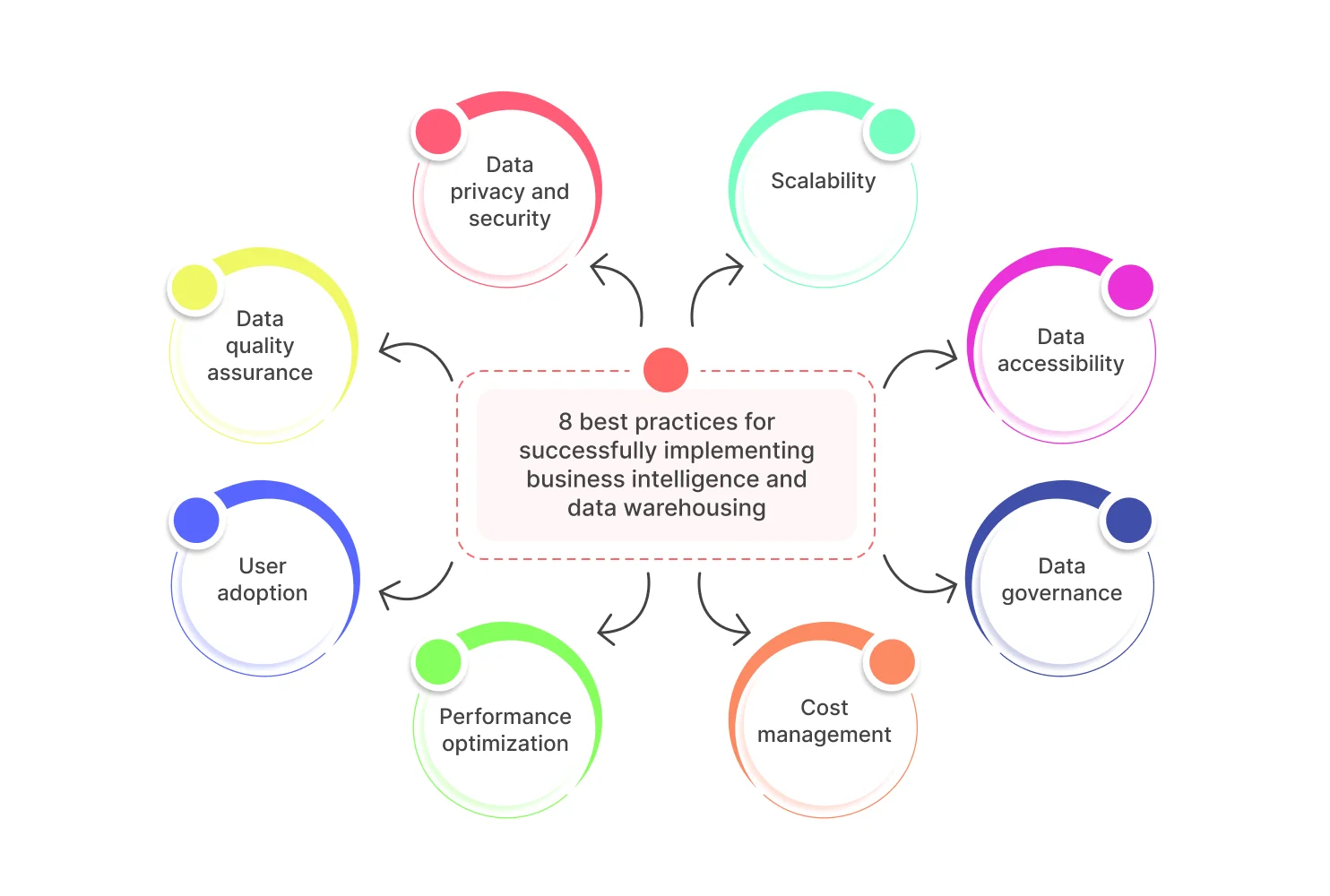
- Data privacy and security: Security measures like encryption and stringent access controls protect sensitive data and comply with applicable laws.
- Scalability: Cloud data warehouses can efficiently store and analyze large datasets, giving you the flexibility to accommodate growing demand and data volume.
- User adoption: Training and user-friendly technology should be provided so employees can retrieve data, evaluate findings, and make intelligent decisions.
- Performance optimization: Optimizing machine and indexing techniques during periods of high data quantities allows for the continuing operation of BI tools and data warehousing systems.
- Data governance: By designing and implementing a governance framework that focuses on data ownership, stewardship, and documentation, you can make decisions with integrity.
- Data quality assurance: Constant monitoring to support credible BI insights inside the data warehouse environment guarantees precise data.
- Cost management: Optimizing resource utilization and performing cost-benefit analyses helps you manage BI and data warehouse costs.
- Data accessibility: BI tools and dashboards work in concert with the data warehousing environment to allow easy access to data.
From what we’ve learned, data warehousing and business intelligence both play pivotal roles in employing the power of data for business success.
Conclusion
Understanding how BI tools and data warehousing support each other empowers you to turn raw data into valuable, actionable insights. When implemented effectively, these systems enhance decision-making, improve operational efficiency, and support long-term strategic goals. Bold BI® simplifies this process by offering powerful visualization and analytics capabilities.
Ready to take the next step? Start your free Bold BI trial or contact our team to transform your data strategy today.