
Succeed with BI in Sports: Benefits, Challenges & Tools

Business Intelligence (BI) intervention in the sports industry has changed field games and enabled sports managers to learn the power of data. This covers the players, fans, and sports in general. Using BI in sports, organizations can gain insights into performance and make accurate decisions that enhance the experience and achieve the main objective. This article explores the BI process in sports and its significance in enhancing the industry.
What is business intelligence in sports?
Business intelligence collects, organizes, and analyzes data to help organizations gain insight to improve operations, increase profits, and make informed decisions.
Business Intelligence in sports involves the processes and technologies used to transform raw data into information that can benefit sports organizations. Also, it helps players measure and monitor their health and capabilities.
Why is business intelligence critical for sporting success?
BI provides insight for data-driven management decisions, helping teams strengthen their competitive games. Key reasons for this include:
- To strategically organize sports activities.
- To monitor and track games.
- To improve player protection in the game.
- To decide on the right coach, trainers, players, and team.
- To maximize sports performance analysis and optimization.
With BI, you can make sports management successful and increase customer satisfaction.
The benefits of using business intelligence in sports
Business intelligence integration has changed the sports industry, enhancing efficiency and collaboration to achieve growth. Key benefits of BI in sports include:
- Nurturing players’ talents and skills.
- Effective planning and management.
- Increasing decision-making using data.
- Enhanced transparency.
Nurturing players’ talents and skills

Using BI, a coach can easily identify each player’s potential. By knowing the player’s ability, the coach improves and nurtures the player for a specific position in the game. Also, the coach adds skills to the player that satisfy the expectations of stakeholders who will continue to provide support, thus increasing the team’s revenue.
Effective planning and management

Using field data helps sports managers plan the sports process effectively. This is done by scheduling all the game activities on time, such as venue, ticketing and pricing, referees, coaches, teams, and more. This has led to an increase in teams registering for games and kept the competition stiff and high, enhancing the productivity of the sport’s industry.
Increasing decision-making using data

Team leads can now track the performance of their teams efficiently to make data-driven decisions on a game. BI has improved the data visualization process, providing analysis with operation insights. This has improved the management of each team to make defined solutions in the sports industry and participate actively to be crowned champion of improving the team’s performance.
Enhanced transparency

Use of business intelligence tools has increased transparency in sports based on data and analytical evaluation. Tools such as GPS trackers, cameras, magnetometers, body sensors, and more are used to clarify each game’s performance. This has helped the game-master control the sport’s operations and focus on the primary objective of the industry to generate more income and increase customers for its services enhancing engagement.
How sports data is collected and analyzed with BI
The following processes are involved in collecting and analyzing data using a BI tool.
Data collection
Sports industry organizations gather information from many sources, such as devices, wearables, video analysis, social media, and other third-party platforms. Organizations can centralize and manage vast amounts of data by storing it in a data warehouse or data lake.
Data cleaning
Data is cleansed and pre-processed after it is gathered. Errors, duplicates, or missing numbers in the data are eliminated. This ensures the accuracy and consistency of the data, which is essential for accurate analysis.
Data analysis
Some business intelligence technologies used to assess data after cleaning include data visualization, predictive analytics, and machine learning algorithms. They are used to analyze data and find patterns, trends, and correlations that might reveal important details about player performance, team tactics, and other elements of a sport.
Dashboard creation
Data visualization tools, such as dashboards, provide a clear and understandable graphical representation of data. They are then used to convey insights discovered through data analysis to stakeholders. Also, stakeholders can make data-driven decisions based on the insights shared by dashboards.
BI tools overall assist sports organizations in gathering, cleaning, analyzing, and visualizing vast amounts of data, enabling them to gain insightful knowledge and make fact-based decisions.
Business intelligence tools for sports
Business Intelligence (BI) solutions help sports organizations and teams in gathering, analyzing, and visualizing data from various sources to make informed decisions and improve their performance. Here is an overview of the various BI tools available for sports:
- Dashboards allow sports organizations to monitor the performance of players and teams and can be customized to showcase different KPIs such as revenue, attendance, performance, and social media engagement.
- Visualization tools enable sports organizations to understand data by presenting it in graphs and charts. This helps identify trends, patterns, and outliers in data to make informed decisions.
- Predictive analytics software helps sports organizations forecast revenue, player performance, and fan engagement.
- Social media analytics allows sports organizations to track their social media performance—fan engagement, sentiment analysis, and brand reputation.
- Data warehousing enables sports organizations to access and analyze data easily.
How business intelligence can be used to achieve sporting success
Integrating Business Intelligence (BI) software has transformed how sports organizations operate and analyze data. Let’s see some real-time examples showcasing business intelligence’s power in sports.
London Olympics 2012 medal tracker
The Olympics teams relied on various data sources such as player statistics, scouting reports, and video analysis to understand each player’s strengths and weaknesses. This helped them make strategic decisions about player selection, game plans, and in-game adaptations. With the London 2012 Medal Analysis Dashboard, a team could track each country’s overall performance and medal count (gold, silver, and bronze). They also could evaluate the popularity and success of each sport.

Football World Cup stats and trends
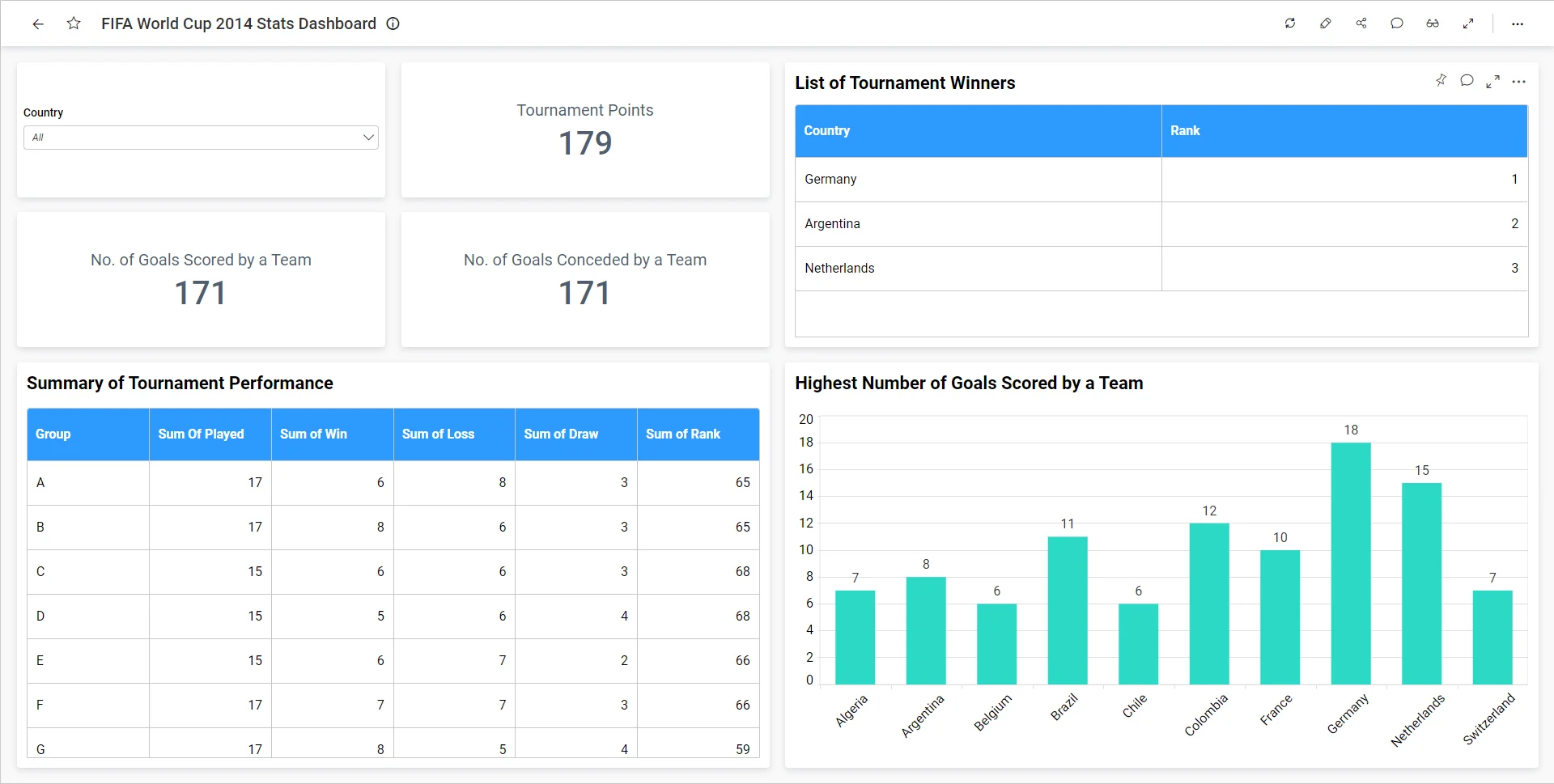
A FIFA World Cup 2014 Stats dashboard offers valuable insight into the 2014 Football World Cup, including tracking goals scored, conceded, and target goals for baseline comparison and strategic planning. Customization features of the BI tool allow for filtering and viewing performance data for each qualifying nation, aiding team managers in understanding performance and gaining insight for future tournaments.
The Rio 2016 Summer Olympics Medal Analysis
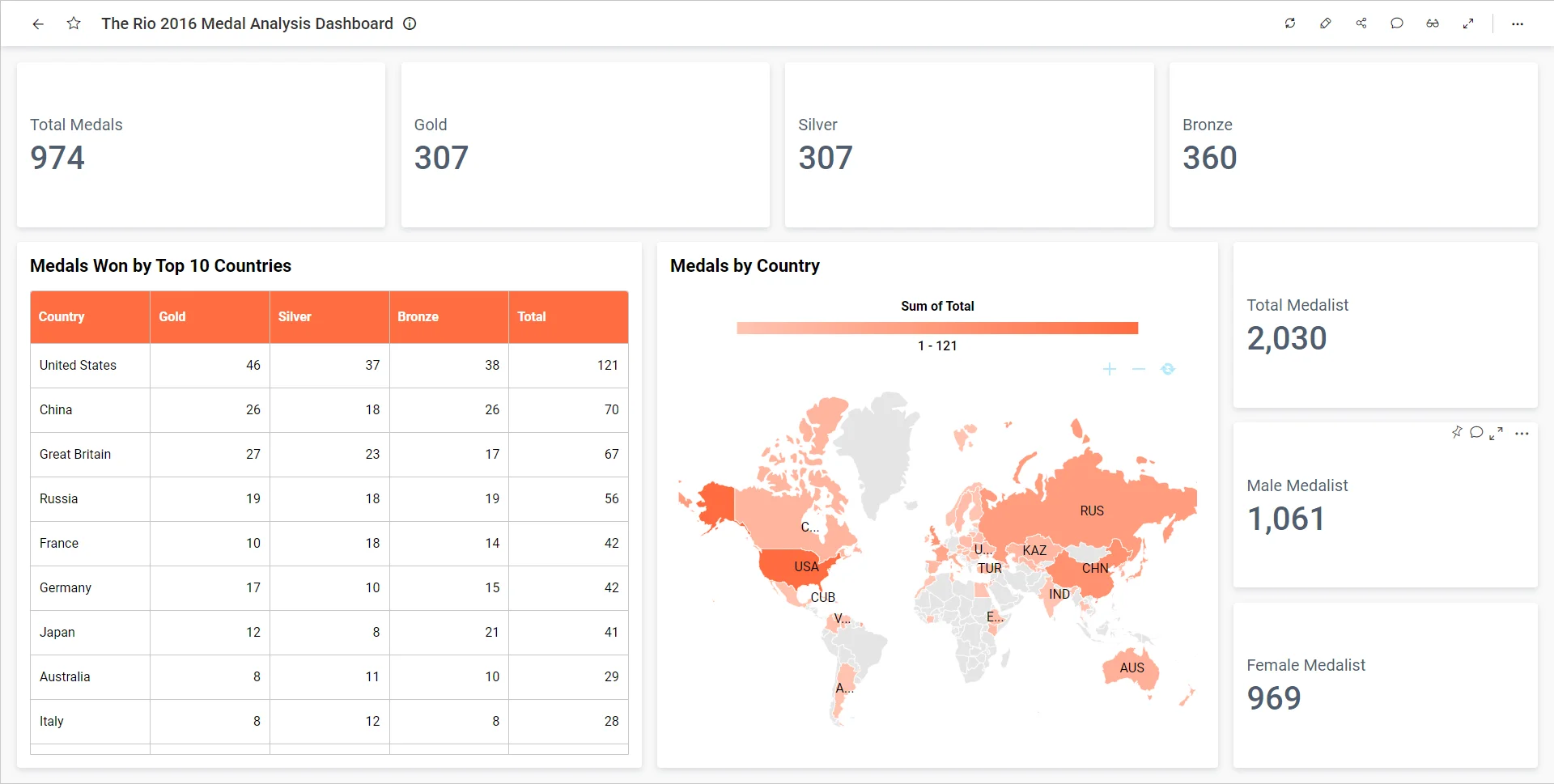
The Rio 2016 Summer Olympics Medal Analysis Dashboard helps evaluate the strength of each country by identifying total medal counts for easy comparison. The dashboard provides a comprehensive overview of the medals won in the 2016 games. Real-time information on athlete performance, current affairs, venue locations, and the event schedule keeps stakeholders informed and engaged during the event.
Challenges of BI in sports
Working with BI, the sports industry faces some difficulties in the process. This includes:
- Data security: Due to fetching data from open fields and different sources, security is critical, compelling sports organizations to implement strong data security measures.
- Implementation cost: BI tools can be expensive—such as the software, employing skilled professionals, maintaining the system—particularly for smaller organizations.
- Quality of data: Data from multiple stores can be noisy, incomplete, or inaccurate, making it difficult to draw meaningful insights.
- Integration of data: Collecting data from more than one source varies the data and formatting, affecting analysis when comparing data across disparate systems.
- Skilled personnel: Finding and hiring top personnel in the sports organization is a difficult endeavor.
The future of BI in sports
BI will be essential for teams and organizations to understand player performance, fan engagement, income streams, and other factors in the future. Here are a few other factors:
- Increased emphasis on real-time analytics to enable users to make quicker decisions based on real-time data and optimize their performance amid the game.
- The use of wearables and internet devices enables users to accurately track players’ information, thereby making informed decisions about player training and development.
- The adoption of machine learning and AI enables users to identify patterns and insights that would be difficult to detect manually.
- Improved fan experiences will help teams gain a deeper understanding of their fans, enabling them to create targeted marketing campaigns.
The future holds many promising and beautiful things for the sports industry, mostly using business intelligence analytical tools and technologies.
Bold BI® is the perfect software tool for sports organizations to analyze and transform data to meet their goals and improve performance. It also allows end-users to access analytics within the context of their applications through embedding, making it easier to use.
With a free trial, you can create interactive sports analytics for strategic decision-making. If you need assistance, you can reach us by submitting questions through the Bold BI website, or if you already have an account, you can log in to submit your support question.