
Top Embedded Analytics Tools for SaaS Product Teams in 2026

TL;DR: In 2026, many SaaS teams treat embedded analytics as an increasingly important product capability. Choosing the right embedded analytics tools depends on integration flexibility, multitenant security, scalability, and developer experience. This guide outlines what to look for and highlights leading embedded analytics platforms built for modern SaaS needs.
Introduction
In 2026, SaaS users expect answers inside the applications they already use. When analytics workflows rely on exports or separate reporting tools, teams may lose momentum and decisions can be delayed. As customers demand faster insights, product managers and engineering teams increasingly prioritize built-in analytics that align with daily workflows. The goal is to support value delivery without making users leave the product.
That’s where embedded analytics tools come in, enabling SaaS teams to integrate dashboards, reports, and interactive insights directly into their applications. By meeting users inside the product instead of switching to external BI tools, analytics shifts from passive reporting to active, day‑to‑day decision support. In this blog, we will explore what makes embedded analytics effective for modern SaaS products and highlight five leading embedded analytics platforms designed to meet 2026 SaaS requirements. Let’s get started.
Who this guide is for
This guide is intended for teams involved in building, scaling, and optimizing analytics within SaaS products, including:
- SaaS product managers and product owners who want to deliver data-riven features and surface insights directly within their applications.
- Engineering leads and developers responsible for implementing and maintaining embedded integrations and data security.
- CTOs and technical decision-makers evaluating build-versus-buy options for embedded analytics platforms.
- Customer success and operations teams seeking better visibility into product usage, customer behavior, and performance metrics.
- Startup founders and SaaS leaders designing scalable, analytics-driven product experiences to support growth and retention.
Readers who want to strengthen adoption, reduce reporting workload, and improve customer satisfaction will gain clear insights from the following sections.
What are embedded analytics tools for SaaS?
Embedded analytics tools are solutions built directly into a software application, allowing users to access data insights within the same product they use for daily work. Rather than positioning analytics as a separate destination, these capabilities are delivered as a native part of the overall SaaS experience.
For example, a user on a marketing team can filter to show campaign performance, compare regions, and download summaries without leaving the main application. This integration reduces friction and encourages teams to make decisions based on near real-time data.
Next, let’s understand why embedded analytics is so valuable for SaaS products today.
Why embedded analytics matters for SaaS teams in 2026
For product-driven companies, embedded analytics for SaaS enables faster decisions, better feature adoption, and reduced reliance on manual reporting workflows. You’ll be able to:
- Deliver faster decisions inside the product: Embedded analytics surfaces insights directly within the application, eliminating the need to switch tools and enabling users to act on data immediately.
- Increase product adoption and engagement: By making insights part of everyday workflows, embedded analytics helps users understand value faster and engage more deeply with core features.
- Reduce development effort and operational overhead: Buying an embedded analytics platform can reduce the engineering effort required to build, secure, and maintain analytics data compared with building everything in-house, especially depending on your requirements and team size.
- Improve collaboration with shared data: Embedded dashboards provide a consistent view of data across teams, reducing reporting back-and-forth and alignment issues.
- Differentiate your SaaS product: Products with built-in insights powered by embedded analytics software stand out by helping users gain value without leaving the application.
- Scale analytics securely as your SaaS grows: Many embedded analytics platforms offer multitenant patterns, supporting secure analytics across customers when configured correctly.
By using modern embedded analytics software, SaaS teams can turn product data into contextual insights that support day-to-day decision-making.
Next, let’s explore what to look for when evaluating an embedded analytics platform.
What to look for in an embedded analytics platform in 2026
When evaluating embedded analytics platforms, SaaS teams should focus on the abilities that support scalability and security. Here are some of the top features to look for:
- Brand consistency and white-labeling: The platform should allow full customization of themes, layouts, navigation, and branding so analytics feels like a natural part of your SaaS product.
- Flexible embedding options: Look for support across JavaScript frameworks, SDKs, and iFrame embedding to match your application architecture and frontend stack.
- Reliable data connectivity: The platform must connect easily to your core data sources and support combining operational, product, and customer data.
- Security and tenant isolation: A strong embedded analytics software should offer SSO, row-level security, and multitenant controls to protect customer data.
- Scalability and performance: Ensure the platform can handle growing numbers of users, dashboards, and tenants without performance degradation.
- Pricing aligned with SaaS growth: Licensing should scale with usage and support multiple environments such as development, staging, and production.
- Developer experience and support: Clear documentation, APIs, code samples, and responsive support help teams integrate a new analytics platform faster.
- Collaboration and shared insights: The platform should support shared dashboards and consistent reporting across teams.
- Deployment flexibility: Look for options such as cloud, private cloud, or on-premises deployment to meet security and compliance needs.
- Enterprise-grade dashboards: Support for high-volume, role-based dashboards is essential for enterprise SaaS use cases.
With these evaluation criteria in mind, the next step is to review the embedded analytics platforms that best align with modern SaaS product and engineering needs.
Top 5 embedded analytics platforms to consider in 2026
In 2026, choosing the right embedded analytics platform depends on support for your needs, like security, scalability, multitenancy, and embedding flexibility.
1. Bold BI
Bold BI® is an embedded analytics platform designed for integration into SaaS products, offering features that support white-labeling and common multitenant security needs like role-based access control and row‑level security.
Key features of Bold BI
- AI-powered analytics: Bold BI uses Generative AI and a Unified AI Agent to turn natural‑language questions into instant insights, automated visuals, and ready‑to‑use dashboards.
- Flexible embedding options: Bold BI supports embedding dashboards using SDKs for JavaScript, React, Angular, Blazor, and ASP.NET, allowing you to integrate analytics into your applications. This is helpful when you want faster integration or simpler isolation.
- Interactive dashboard designer: Our drag-and-drop designer uses charts, grids, filters, maps, and drill-down interactions to display KPIs without heavy development effort.
- Multitenant architecture and security: Bold BI supports multitenant SaaS patterns via tenant-aware embedding, RLS, and role-based permissions.
- White-labeling capabilities: Bold BI enables you to customize themes and UI presentation so your analytics can match your SaaS product experience.
- Broad data connectivity: Bold BI supports common database types and integration patterns, including REST-based sources, enabling you to unify product and operational analytics.
- Automated scheduling and exports: Bold BI supports scheduled email delivery of dashboards in formats like PDF, Excel, or images.
- Flexible deployment options: With support for on‑premises, private cloud, and managed cloud setups, Bold BI allows SaaS teams to deploy analytics in a way that matches their security, compliance, and infrastructure needs.
- Self-service analytics: Using built-in self-service capabilities, Bold BI enables end users to explore data and create dashboards within the application, reducing reliance on engineering teams.
- Enterprise dashboards: Bold BI enables teams to build scalable, role-based enterprise dashboards that support large data volumes.
To see how embedded analytics make a tangible impact, let’s look at how it is applied across industries.
Industry examples of Bold BI’s embedded analytics
Embedded analytics delivers actionable insights directly inside SaaS products for various industries.
Marketing
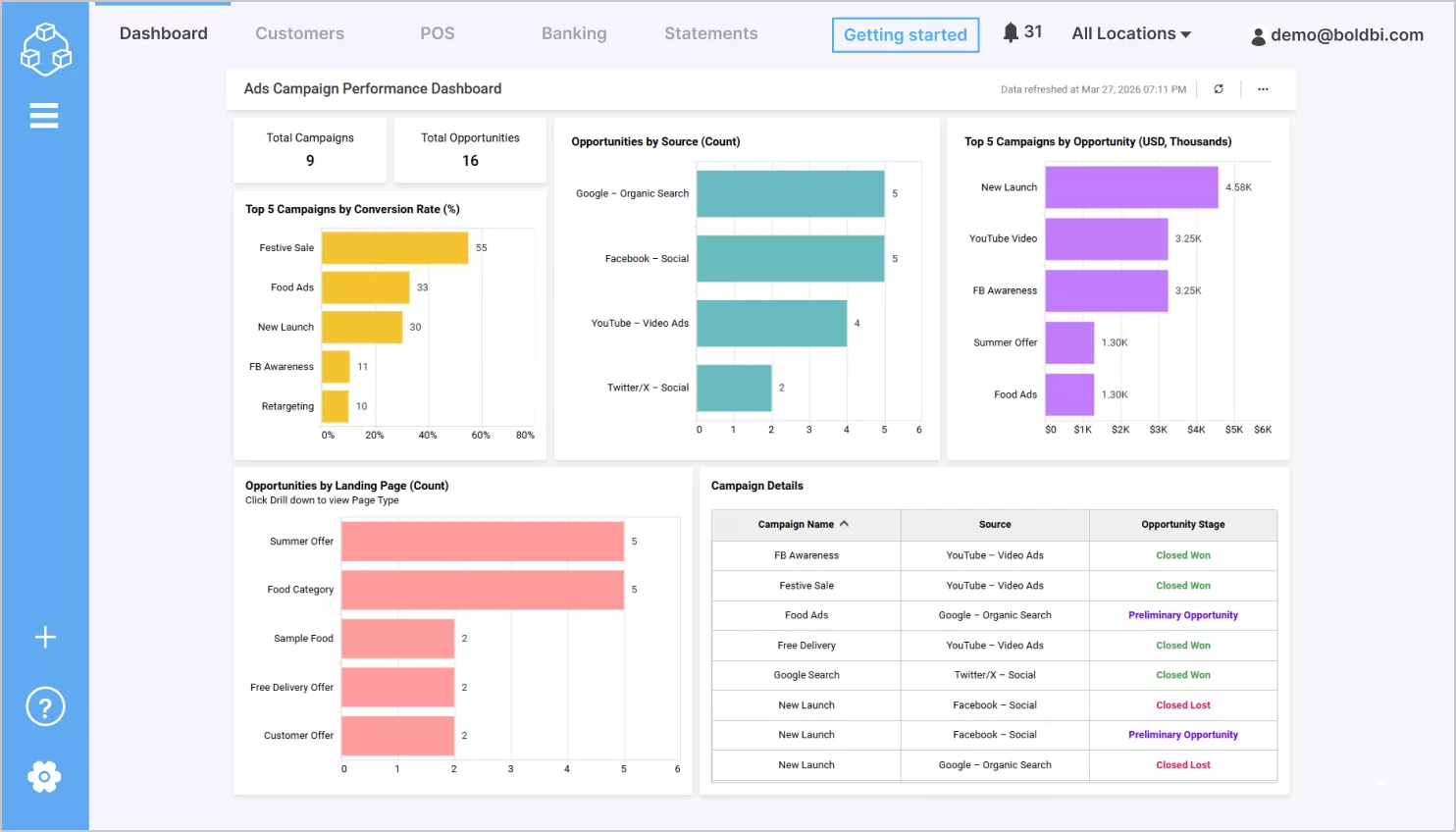
The ads campaign performance dashboard helps marketing SaaS teams track metrics such as conversion rates, opportunities by landing page, campaign by opportunity, and campaign details in one place. By embedding this dashboard directly into a marketing SaaS product, users can quickly identify the highest-performing channels and understand which campaigns drive revenue without exporting data or asking for custom reports.
To learn more about marketing industry, explore our sample dashboards.
Sales
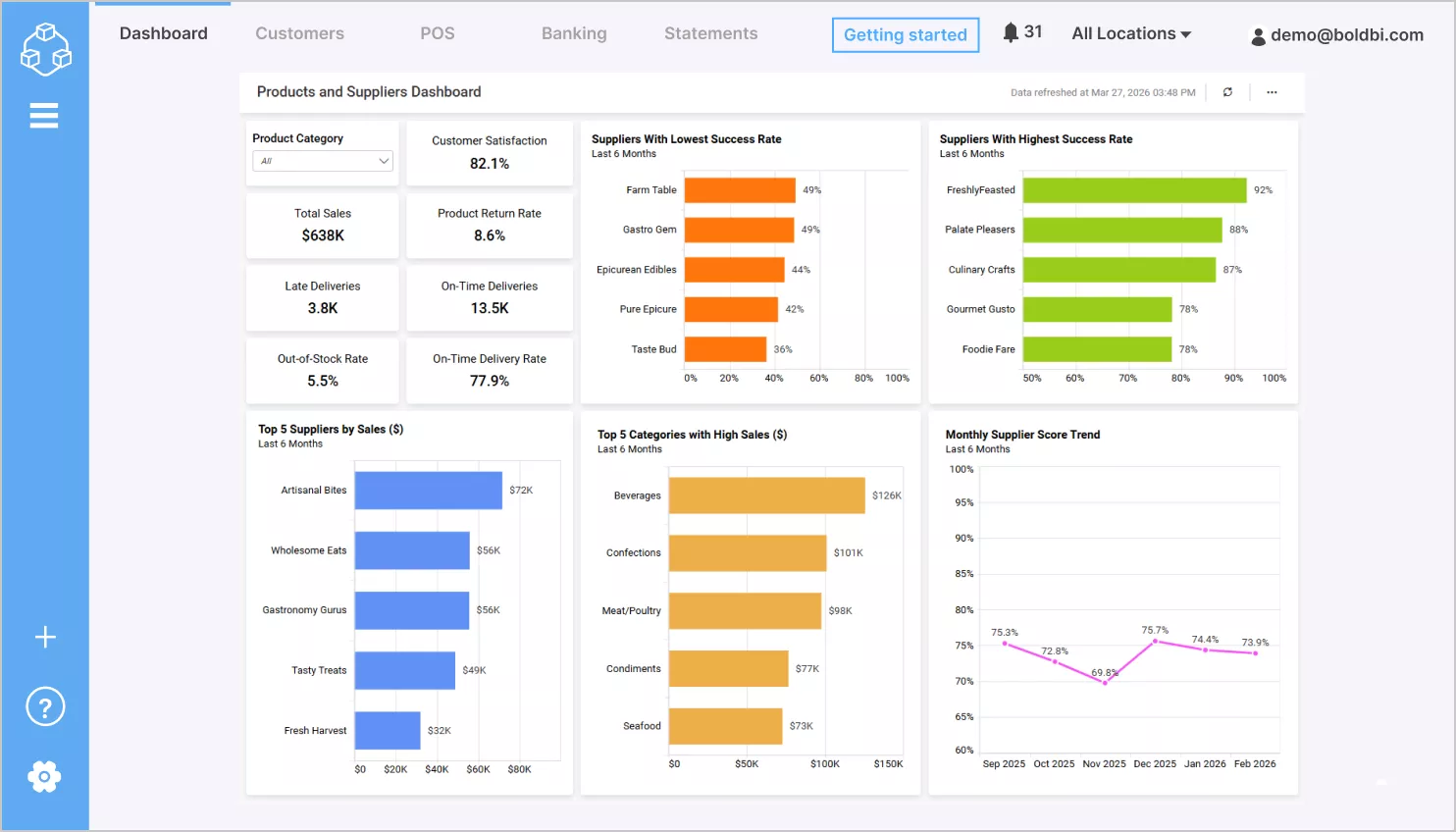
The products and suppliers dashboard helps sales-focused SaaS platforms track sales volume, on-time delivery, customer satisfaction, and supplier success rates. Reduce manual analysis by embedding this dashboard into a sales SaaS environment, where you can gain timely insights into top categories, supplier reliability, and emerging issues.
To learn more about sales industry, explore our sample dashboards.
Oil and gas
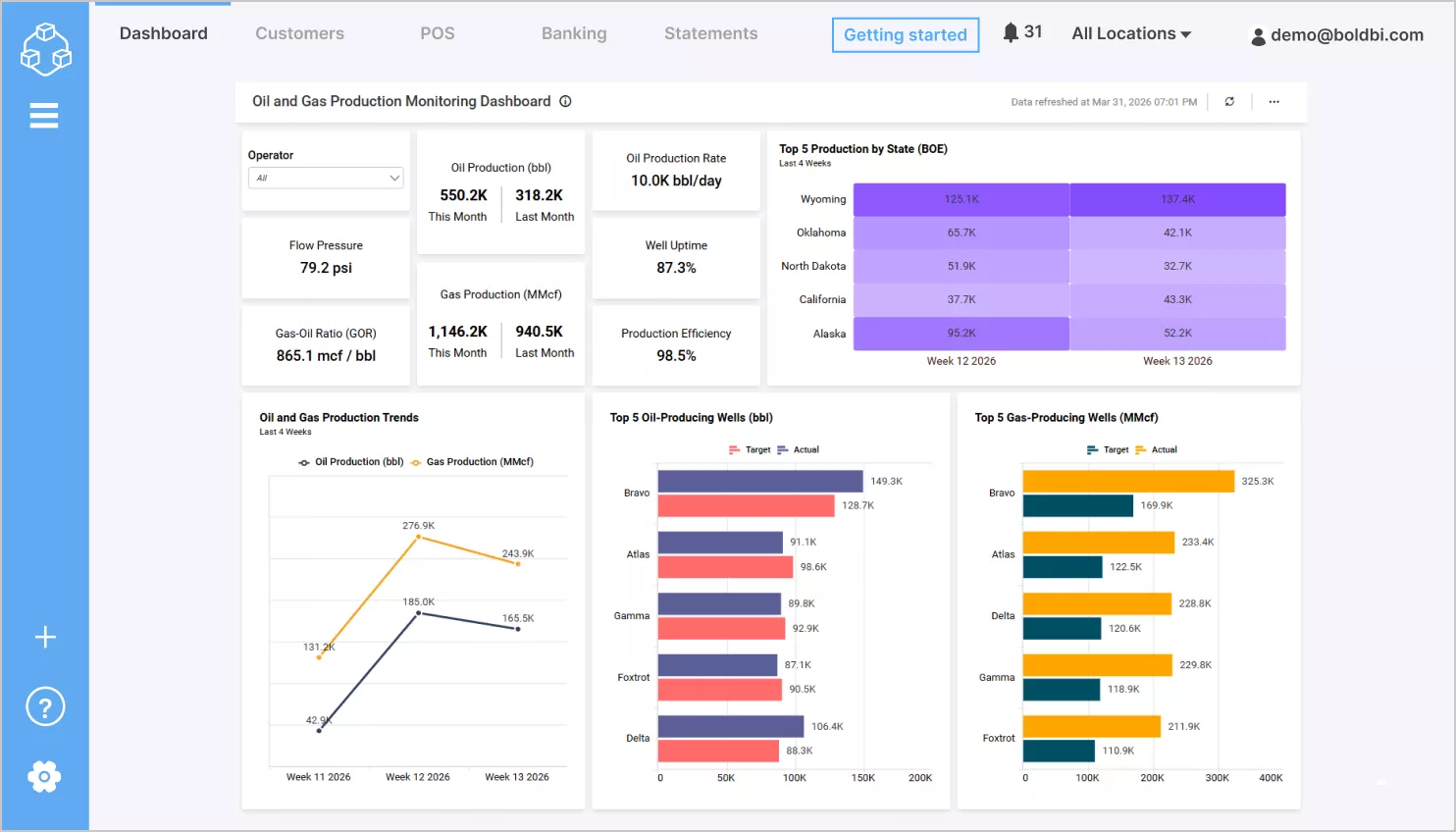
The oil and gas production monitoring dashboard empowers oil and gas SaaS platforms to track production rates, uptime, efficiency, state-level output, and top-performing wells at a glance. Embed this dashboard to eliminate spreadsheet-based updates, monitor field performance in real time, and support faster, data-driven operational decisions.
To learn more about oil and gas industry, explore our sample dashboards.
Education
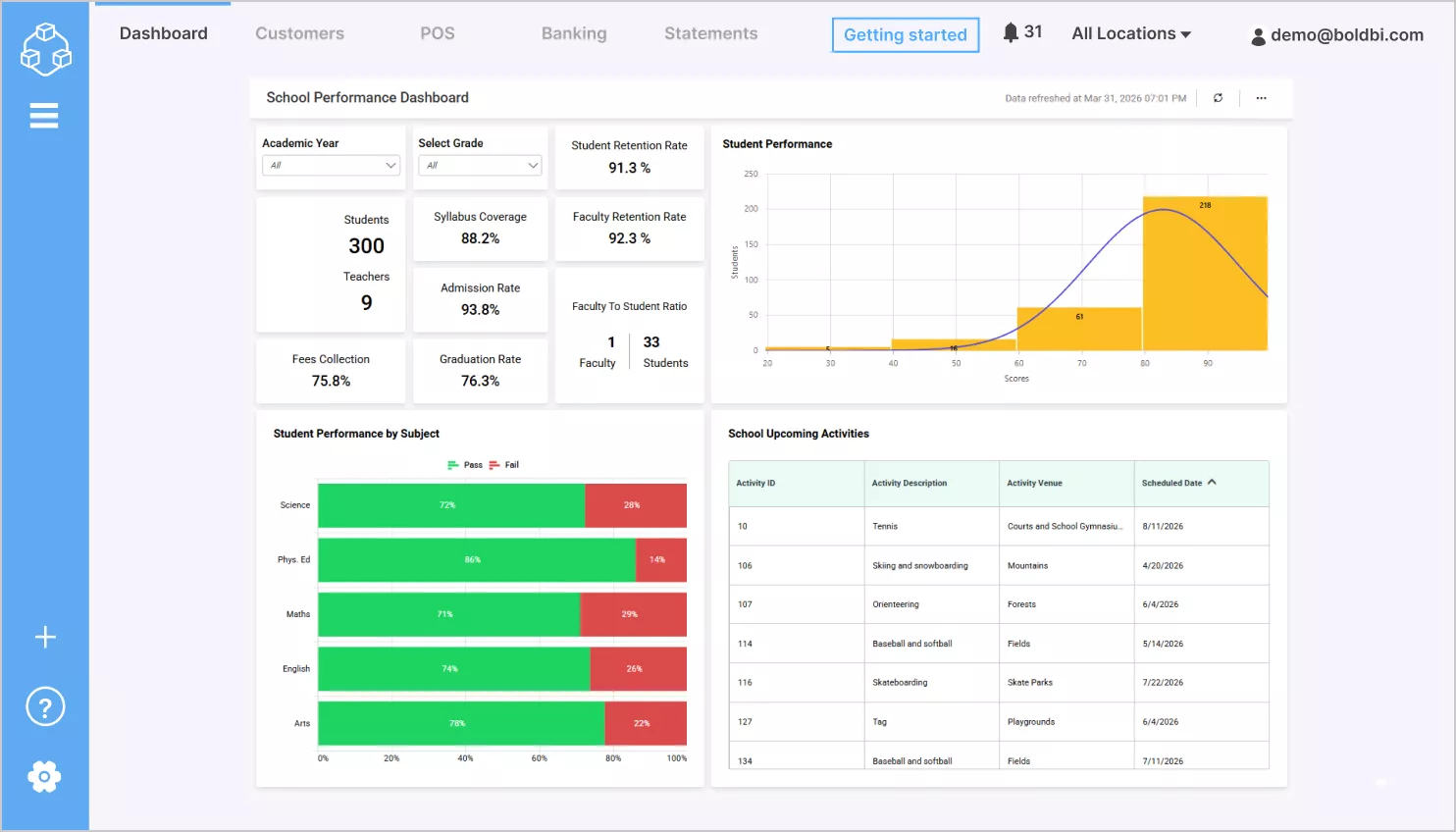
This school performance dashboard helps education SaaS platforms track key student metrics like student retention rate, subject performance, faculty ratios, and upcoming activities in one place. When embedded within an education application, this dashboard gives educators instant access to insights. Educators can identify performance gaps early, plan interventions for underperforming students, and plan in a more data-driven way.
To learn more about education industry, explore our sample dashboards.
These dashboards represent only a small subset of what Bold BI is capable of. Visit the dashboard samples page to explore real‑world dashboards across industries and use cases. You can also learn more about Bold BI by visiting our website to explore its full features or check out our blog on why you should choose Bold BI for embedded analytics.
Beyond Bold BI, several embedded analytics platforms offer different strengths depending on organizational requirements.
2. Power BI
Power BI Embedded provides Microsoft’s embedding capabilities for organizations building on Azure and the Microsoft ecosystem.
Key features
- Powerful data visualizations: Create interactive charts, graphs, and maps that help users explore data inside your application.
- Customizable user interface: Align embedded reports with your product’s branding using flexible layouts and styling options.
- Secure and scalable platform: Use Azure-backed security and infrastructure to protect data and support large-scale deployments.
- Pre-built connectors: Connect quickly to common data sources through built-in connectors for faster integration.
Explore how Power BI compares to Bold BI in embedded scenarios.
3. Tableau
Tableau offers embedded analytics through its APIs, with strengths in visual exploration and enterprise governance.
Key features
- Data connectivity: Connect to diverse data sources across cloud, on‑premise, and APIs for unified analysis.
- Flexible deployment: Deploy in cloud, on‑premise, or hybrid environments to meet scalability and infrastructure needs.
- Centralized governance: Manage authentication, permissions, and compliance controls from a single place to ensure consistent data access across the organization.
- AI‑powered insights: Generate automated insights using Tableau Pulse and Tableau Agent to identify trends and patterns quickly.
Find out how Tableau’s embedded capabilities compare to Bold BI’s approach.
4. Domo
Domo Embedded Analytics enables organizations to deliver secure, pre‑built and self‑service analytics directly within their applications, portals, or websites.
Key features
- Ready‑made embedded analytics: Embed pre‑built dashboards and reports into your application or website so users can access analytics immediately without building visualizations from scratch.
- Custom report creation: Interact with data to build their own reports and visualizations, while controlling access so each user sees only the data relevant to them.
- Data blending and exploration: Combine their own data with embedded analytics to uncover deeper insights through a secure and guided integration process.
See how Domo’s embedding experience compares to what Bold BI offers.
5. Qlik Sense
Qlik Sense provides flexible exploration capabilities powered by its associative engine and embedding APIs.
Key features
- AI-powered insights: Keep analytics current with continuously updated, AI-driven insights.
- No-code and pro-code workflows: Build embedded experiences using visual tools or full developer capabilities.
- Embedded analytics: Use prebuilt blocks and connectors to integrate analytics directly into application workflows.
- Seamless data integration: Connect and prepare data from multiple sources using Qlik Talend Cloud to ensure trusted, consistent analytics.
Learn how Qlik’s embedded features compare to Bold BI.
Transform your SaaS product with embedded analytics
Embedded analytics is increasingly important for many SaaS products because users expect fast, contextual insights inside the applications they use every day. When analytics is delivered in the flow of work, teams make decisions faster and customers understand value sooner. The strongest platforms support branded experiences, flexible embedding, secure data access, scalable performance, cost alignment, and developer tools that help teams move quickly.
If you want an embedded solution that meets these needs with flexibility and security, Bold BI® is a good fit. You can embed dashboards quickly, shape the experience around your product, and deliver insights that make your application more valuable. For teams ready to move from concept to implementation, refer to our blog on how to embed analytics into your application as a starting point. You can also refer to our documentation on embedding options and learn how Bold BI supports embedding dashboards into your applications.
Ready to start embedding powerful analytics? Start your Bold BI free trial or request a personalized demo and explore how to embed secure, scalable analytics into your SaaS product.
Frequently asked questions
- 1.
What is embedded analytics for SaaS?
Embedded analytics is the practice of putting dashboards and reports directly inside a SaaS application so users can explore insights without leaving the product.
- 2.
Which embedded analytics tools are most common in 2026?
Common platforms include Bold BI, Tableau Embedded, Power BI Embedded, and Qlik Embedded.
- 3.
What matters most when comparing embedded analytics platforms?
Key factors include embedding flexibility, multitenant support, row-level security, white-labeling, data connectivity, developer experience, and predictable pricing.
- 4.
Can embedded analytics be white-labeled?
Yes. Many SaaS teams prioritize white-labeling so embedded dashboards match the product UI and feel native to users.
- 5.
How do I keep customer data separated in embedded analytics?
Use tenant-aware access controls like row-level security and role-based permissions, pass tenant context from your application to the analytics layer, and validate data separation with real multitenant test scenarios before launch.