What Is Enterprise Analytics? Why It Matters & How It’s Used


 9 min read
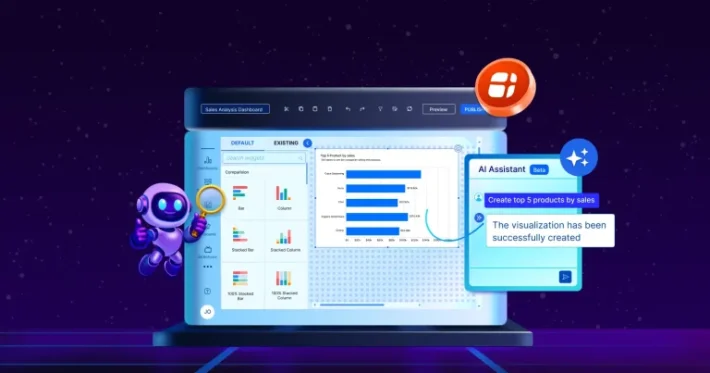
TL;DR: Enterprise analytics is most effective when every dashboard, embedded view, and AI answer uses the same governed data and access rules. It combines data from across an organization to support faster, better-informed decisions. Bold BI® supports this with 145 data connectors, three deployment editions (Cloud, Managed Private Cloud and On-Premises), and embedded analytics through its JavaScript SDK.
Organizations generate vast amounts of data, but disconnected systems and inconsistent analytics often make it difficult to turn that data into actionable insights. Enterprise analytics helps unify data from multiple sources, enabling faster, more informed decision-making across the organization.
What is enterprise analytics?
Enterprise analytics is the process of collecting, integrating, analyzing, and visualizing data from across an organization to support strategic and operational decision-making.
Unlike traditional analytics, which primarily focuses on historical information, enterprise analytics combines near real-time data, self-service analytics, predictive insights, and advanced analytics. This is designed to provide a comprehensive view of business performance. It allows stakeholders across departments to access trusted data and make decisions based on facts rather than assumptions.
Enterprise analytics typically brings together data from:
- ERP systems
- CRM platforms
- Financial applications
- Operational systems
- Customer-facing applications
- Data warehouses and cloud platforms
The goal is simple: transform raw data into actionable insights that improve efficiency, reduce risk, and support growth.
5 Benefits of Enterprise Analytics
As organizations grow, data often becomes distributed across departments and systems. Enterprise analytics creates a consistent view of performance and enables teams to make decisions based on trusted information.
1. Creates a single source of truth
Enterprise analytics combines information from multiple systems into a centralized, trusted view. Bold BI supports this through connectivity to 145 data connectors and integrations.
2. Enables proactive decision-making
Near real-time dashboards and predictive analytics help teams identify issues and opportunities earlier, enabling faster decision-making. In Bold BI, each data source can run in Live mode or Extract mode, depending on how fresh the data needs to be.
3. Improves collaboration and customer experiences
When teams work from the same trusted dashboards, they stay aligned on goals and metrics. Organizations can also better understand customer behavior and deliver more personalized customer experiences
4. Strengthens governance and supports compliance requirements
Centralized access controls, auditability, and role-based permissions help organizations protect sensitive information and support compliance requirements.
5. Supports efficiency, scalability, and growth
Analytics platforms automate analysis and monitoring, reduce manual effort, uncover operational inefficiencies, and scale with growing business requirements.
Must-Have Features in an Enterprise Analytics Platform
Choosing the right enterprise analytics platform requires evaluating both technical and business capabilities.
Collaboration, sharing, and governance
A modern platform should provide secure dashboard sharing, collaboration, role-based permissions, and governance controls that ensure users can access only authorized information.
Dashboard creation and customization
Analysts and team leads should be able to create and customize dashboards through intuitive drag-and-drop experiences without requiring extensive technical expertise.
AI-powered analytics and self-service capabilities
Modern enterprise analytics software increasingly includes AI-assisted data exploration, natural language queries, automated insights, and self-service analytics features that help users discover answers more quickly.
Data connectivity and integration
An enterprise analytics platform should connect to a wide range of databases, cloud services, applications, and data warehouses so organizations can analyze all relevant business data in a single environment. Bold BI supports 145 data connectors.
Visualization
Interactive charts, KPI widgets, drill-down analysis, and export capabilities help organizations communicate insights effectively. Bold BI provides interactive dashboards with drill-down capabilities and supports embedding via its JavaScript SDK.
Embedding and deployment flexibility
Many organizations require analytics within customer-facing applications, partner portals, and internal business systems. Look for platforms that support embedded analytics alongside Cloud, Managed Private Cloud, and On-Premises editions.
Security and compliance
In Bold BI, enterprise security includes SSO, role-based access control, row-level security, and audit logs across Cloud, Managed Private Cloud, and On-Premises deployments.
How to Implement Enterprise Analytics Successfully
Start with one measurable goal and your highest-value data sources, then expand.
- Define clear business objectives: Start by identifying measurable goals such as improving customer retention, increasing operational efficiency, or reducing analysis delays.
- Connect high-value data sources first: Focus on integrating systems that contain critical business information before expanding analytics across the entire organization.
- Establish governance policies: Define ownership, access permissions, data quality standards, and analysis practices early to ensure consistency and trust.
- Build role-based dashboards: Different stakeholders require different perspectives. Executives, managers, and operational teams should each have dashboards tailored to their responsibilities.
- Measure adoption and outcomes: Track dashboard usage, analytics efficiency, and business performance improvements to demonstrate value and drive long-term adoption.
Common Enterprise Analytics Challenges
Self-service and governance pull in opposite directions. The more people build dashboards, the more shared definitions and permissions matter, so decide who owns metric definitions before opening self-service access across the organization.
- Data silos: Important information often exists across disconnected systems, making integration and analysis difficult.
- Poor data quality: Duplicate, incomplete, or inconsistent data can reduce confidence in analysis results and business decisions.
- User adoption: Even powerful analytics platforms deliver limited value if employees lack the training or motivation to use them effectively.
- Governance complexity: As analytics adoption grows, organizations must carefully balance self-service access with security, privacy, and compliance requirements.
- Scaling analytics initiatives: Growing data volumes, analysis requirements, and user counts require platforms built for enterprise-scale performance and reliability.
How Bold BI Supports Enterprise Analytics
Bold BI, developed by Syncfusion, provides enterprise analytics capabilities for organizations that need governed, scalable, and embeddable business intelligence.
- Supports 145 data connectors
- Available in Cloud, Managed Private Cloud, and On-Premises editions
- Provides embedded analytics through JavaScript SDK methods
- Supports AI Assistant and AI-powered analytics capabilities
Where Bold BI Has Limits
- The AI Assistant queries one data source at a time, so questions that span several sources need a combined data source first.
- Some capabilities differ by product. For example, Okta SSO through the OAuth/OpenID connectors is available in Bold BI Embedded Analytics but not in Cloud Analytics Server (as of October 2026).
- Bold BI enforces access rules, but your team still defines and owns metric definitions.
Enterprise Analytics Use Cases Across Industries
Enterprise analytics helps organizations solve industry-specific challenges by transforming operational data into actionable insights.
Retail
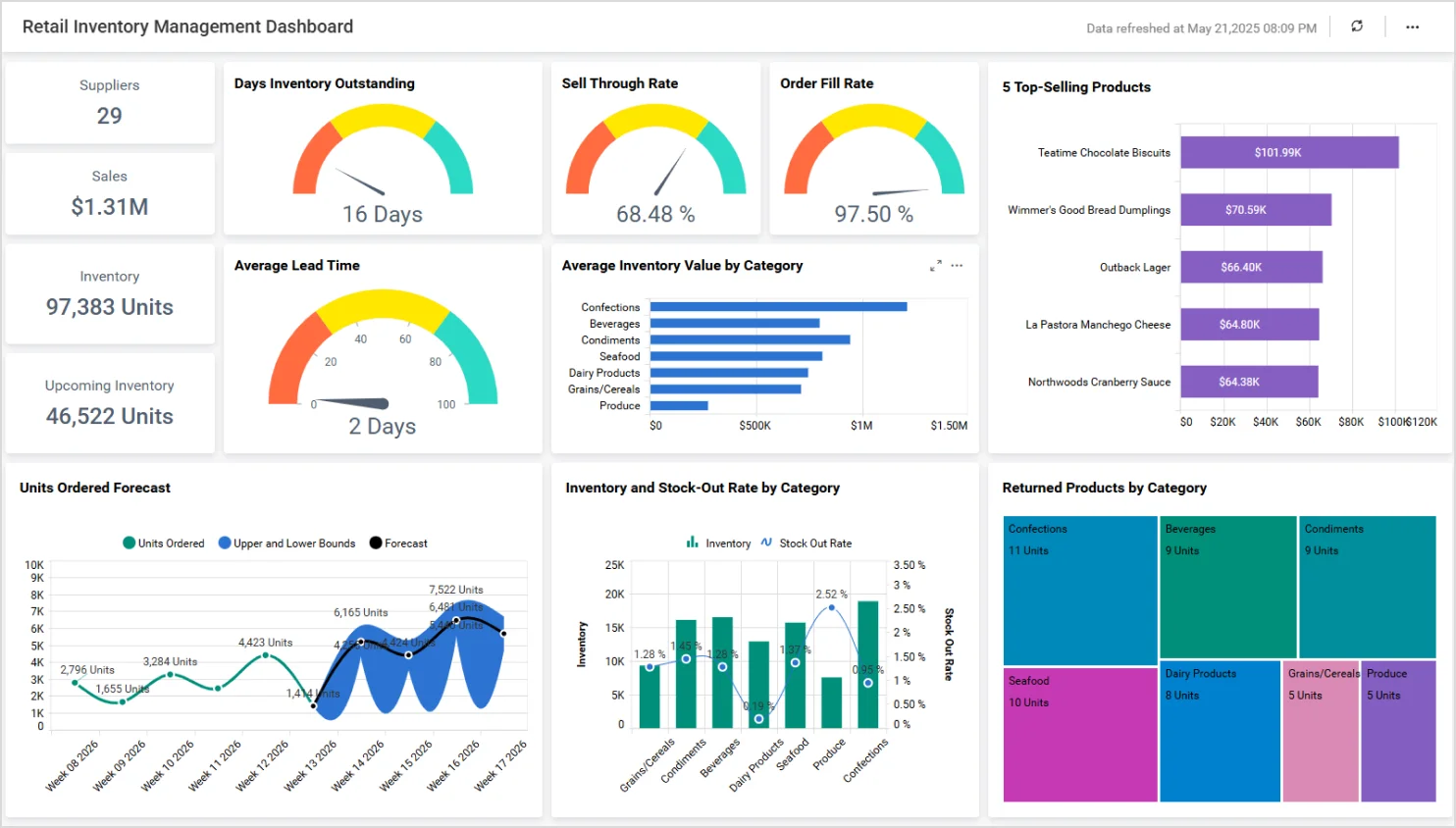
In retail, managers often face challenges like stockouts, overstocking, and shifting customer demand. Enterprise analytics helps address these issues by providing near-real-time metrics on inventory levels, product performance, and order fulfillment. With a retail inventory management dashboard, businesses can optimize stock, reduce waste, and better meet customer needs.
Finance
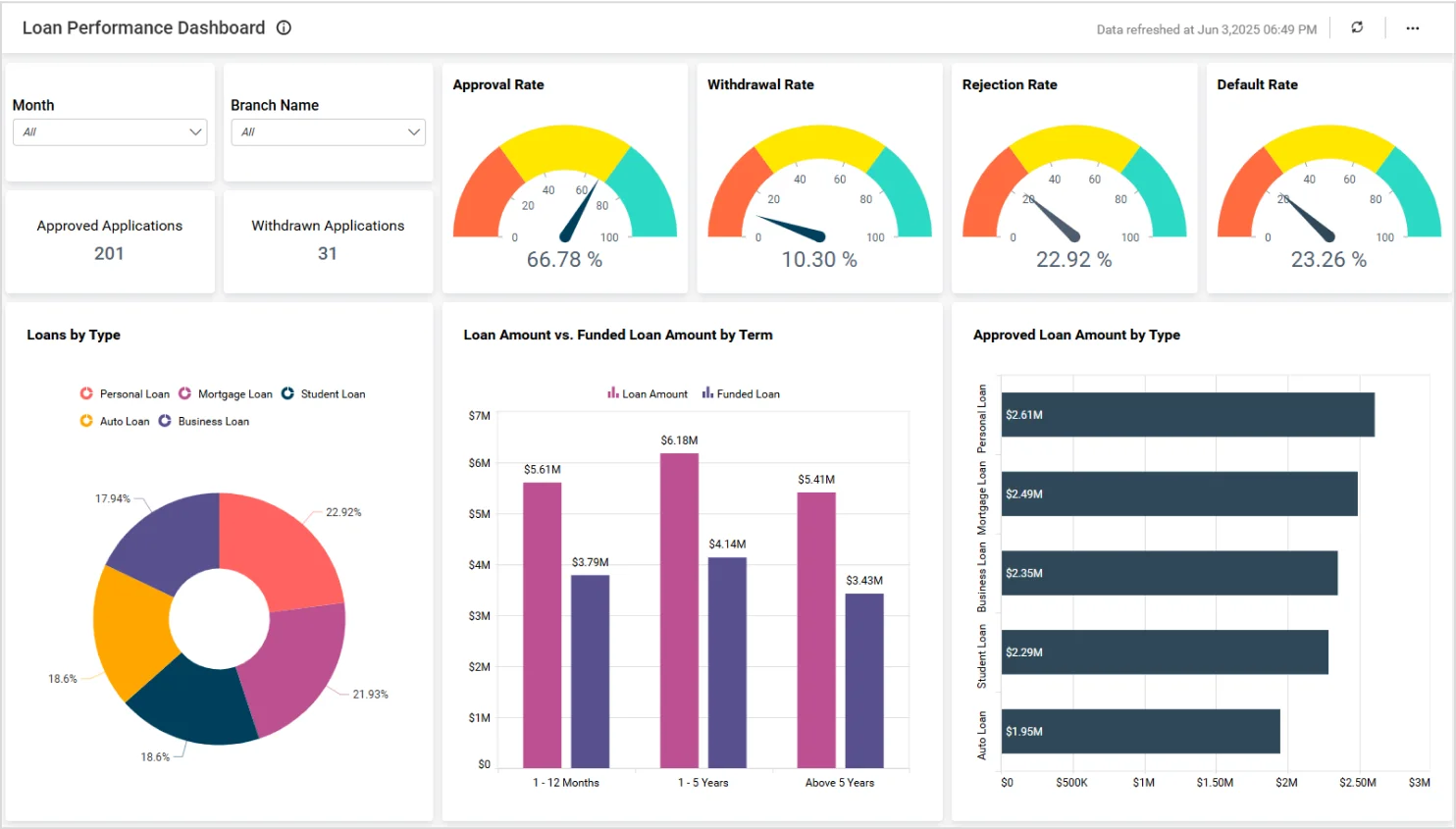
Financial institutions deal with challenges such as risk management, regulatory compliance, and profitability. Enterprise analytics helps monitor large volumes of transactions and loan data in near real-time. A loan performance dashboard tracks approvals, loan types, and rejection rates, enabling early risk detection and better lending decisions.
Manufacturing
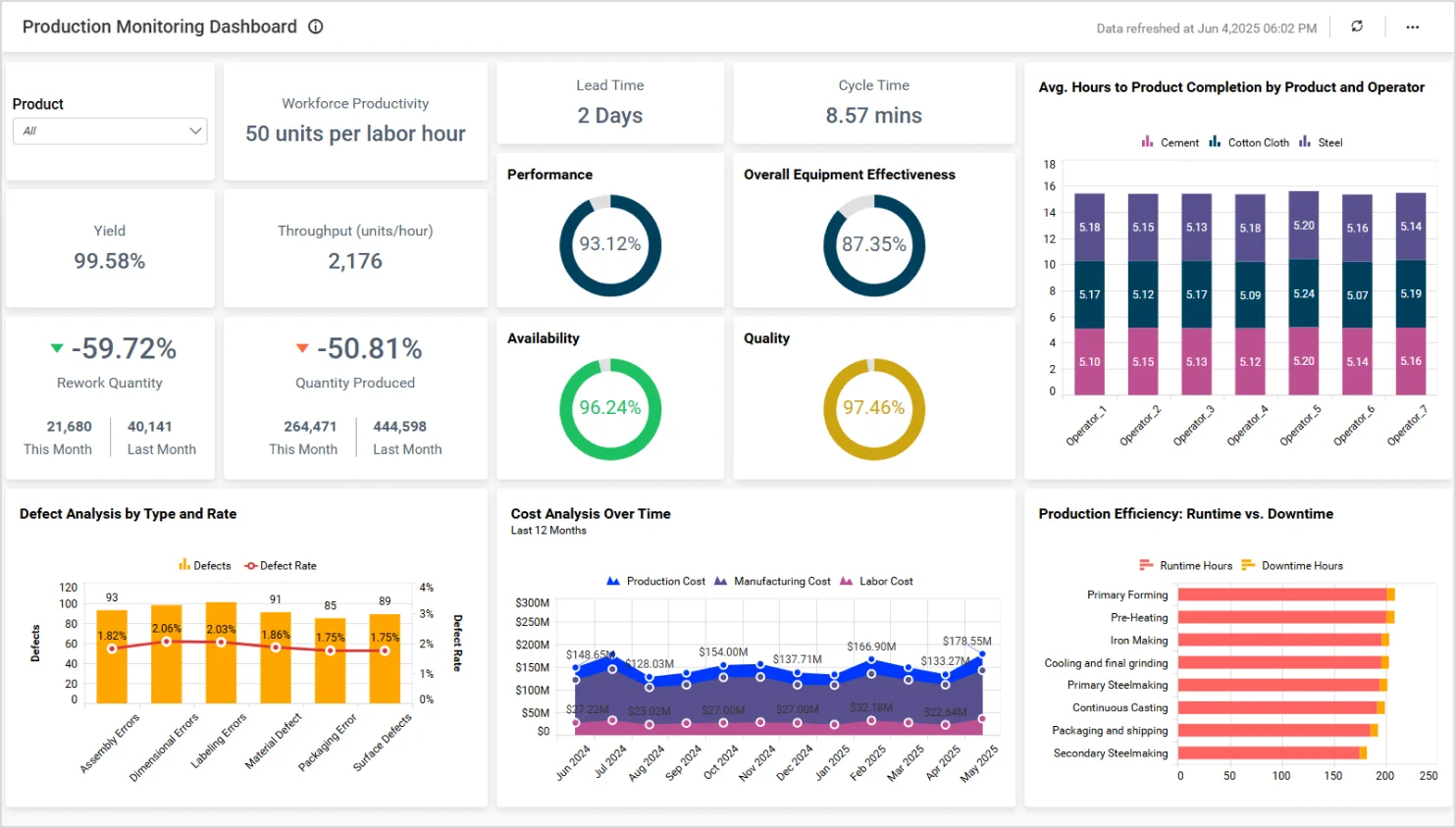
Manufacturers can struggle with production inefficiencies caused by equipment downtime and delays. Enterprise analytics provides better visibility into operations through near-real-time data. A production monitoring dashboard shows defect rates, equipment efficiency, and cost data, allowing predictive maintenance and smoother operations.
Education
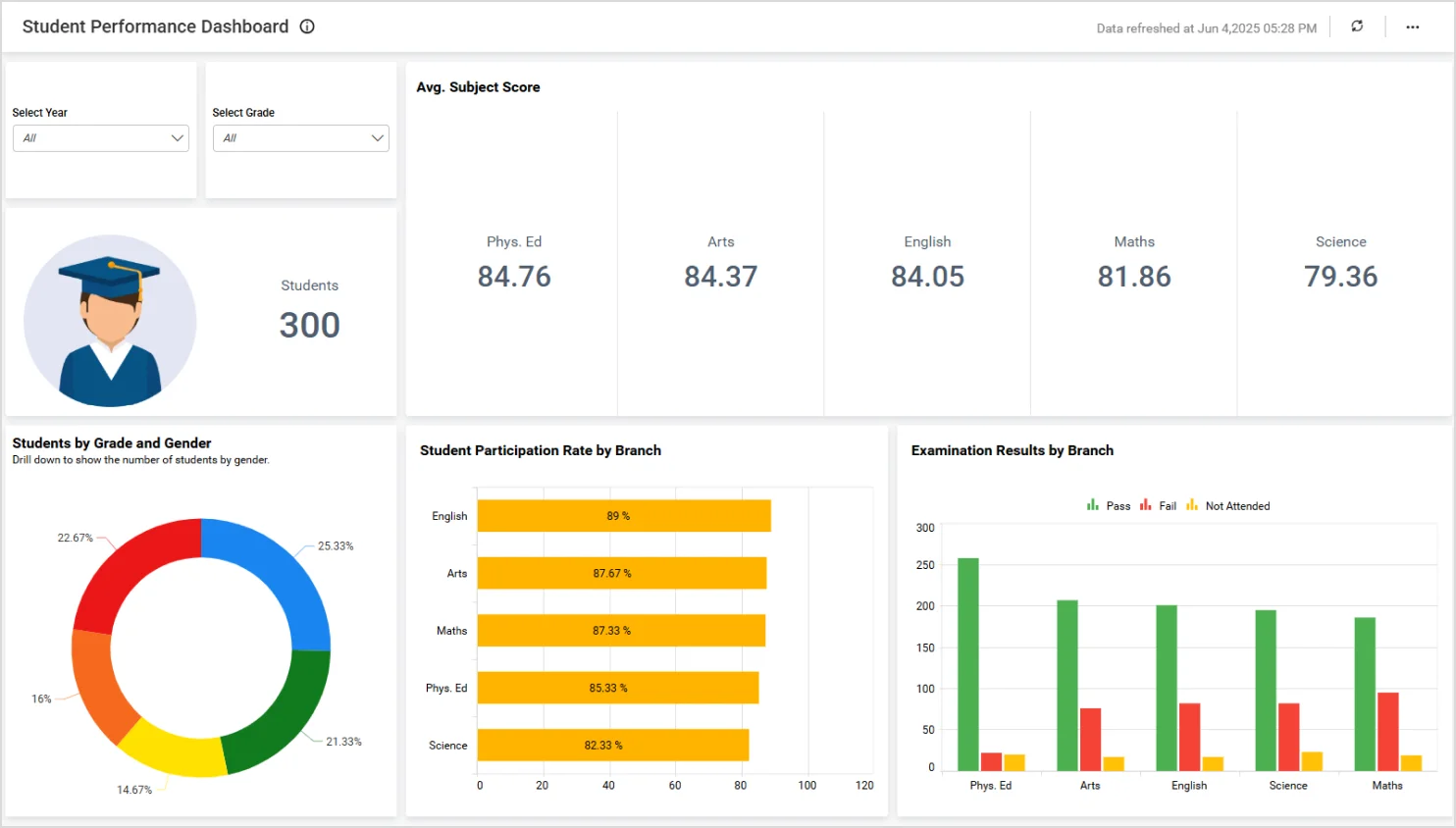
Educational institutions often struggle to monitor student progress effectively and allocate resources efficiently. The challenge is identifying underperforming students early enough to intervene and support academic success. Enterprise analytics gives schools a student performance analysis dashboard to visualize key metrics such as participation rates, exam scores, and student demographics. This can improve student outcomes and optimize resource use.
Healthcare
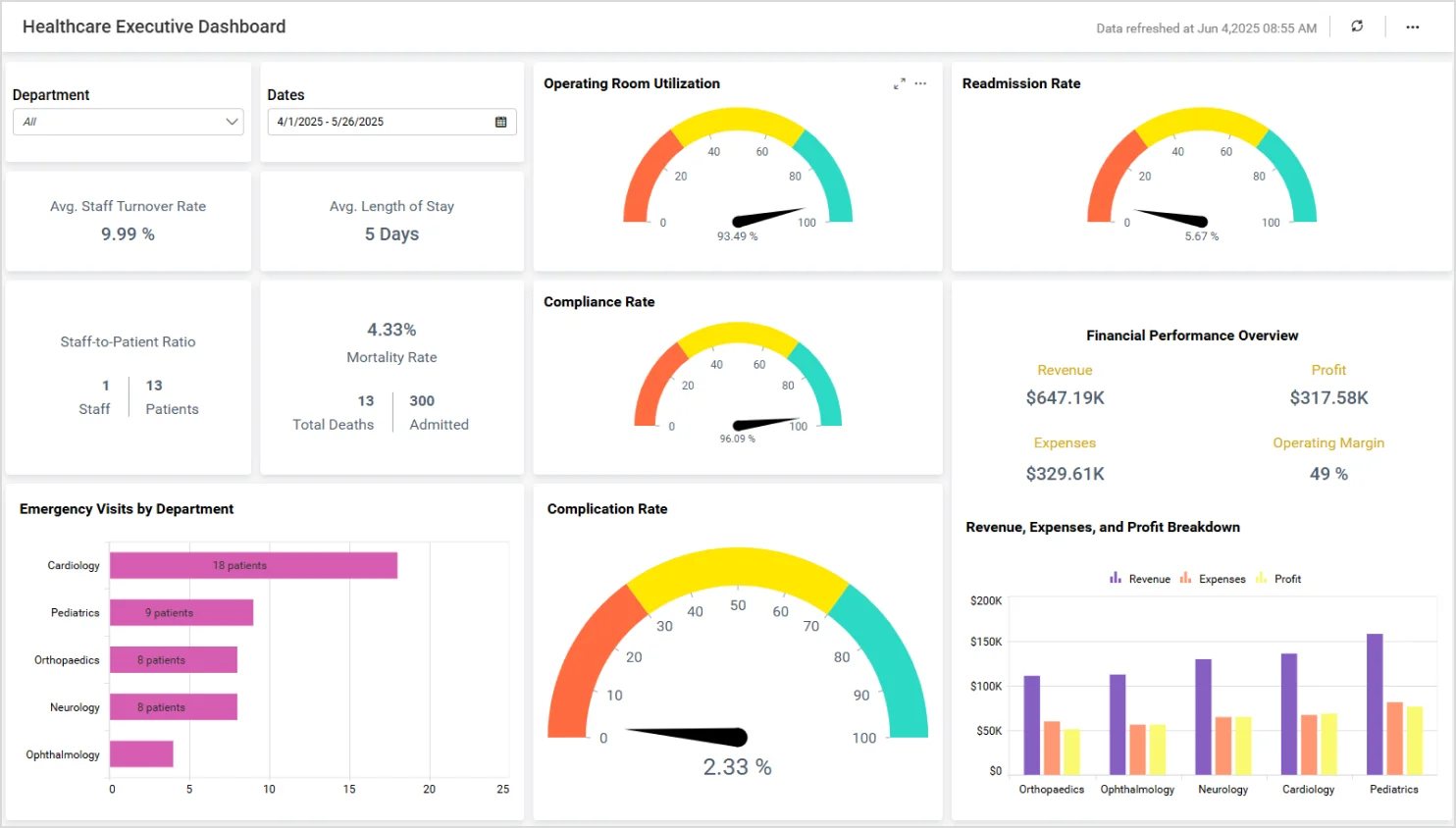
In healthcare, hospitals grapple with the dual pressure of improving patient care and managing operational costs. The challenge includes handling patient readmissions, emergency room loads, and financial constraints. Enterprise analytics supports healthcare providers with a healthcare executive dashboard that tracks these metrics. This enables proactive patient care, optimized staffing, and reduced operational costs, ultimately enhancing patient outcomes and institutional efficiency.
Enterprise Analytics and Business Intelligence
Business intelligence and enterprise analytics are closely related. Business intelligence provides dashboards and data visualization capabilities. While enterprise analytics extends those capabilities across the organization with broader data integration, governance, self-service exploration, predictive analysis, and AI-assisted insights. Together, they help organizations turn data into informed business decisions.
Final Thoughts
Enterprise analytics helps organizations turn data from across the business into trusted insights that improve decision-making, operational efficiency, and long-term growth. Success depends not only on data access, but also on governance, consistency, and broad adoption across teams.
Whether you’re evaluating an enterprise analytics platform for embedded analytics for customer-facing applications, choose a solution with strong integration, governance, AI, security, and deployment capabilities for long-term success.
Ready to realize the full value of enterprise analytics? Start your free Bold BI® trial and see how enterprise analytics can help your organization deliver trusted insights at scale.
Frequently Asked Questions
- 1.
What is enterprise analytics?
Enterprise analytics is the process of collecting, integrating, analyzing, and visualizing data from across an organization to provide a unified view of business performance and support data-driven decision-making.
- 2.
What are the four types of analytics?
The four main types of analytics are descriptive analytics, which explains what happened; diagnostic analytics, which identifies why it happened; predictive analytics, which forecasts what is likely to happen; and prescriptive analytics, which recommends actions to achieve desired outcomes and improve business performance.
- 3.
What is the difference between business intelligence and enterprise analytics?
Business intelligence focuses primarily on dashboards, and historical data analysis, while enterprise analytics extends these capabilities through organization-wide data integration, governance, self-service exploration, predictive analytics, and AI-powered insights.
- 4.
What is an enterprise analytics platform?
The four main types of analytics are descriptive, diagnostic, predictive, and prescriptive analytics.
- 5.
Why is enterprise analytics important?
Enterprise analytics helps organizations make faster, more informed decisions by providing trusted insights from data across the business.
- 6.
How does Bold BI support enterprise analytics?
Bold BI supports enterprise analytics by connecting data from 143 supported data sources, providing interactive dashboards and self-service analytics capabilities, enabling embedded analytics through its JavaScript SDK, and offering governance and security features such as role-based access controls.