
Real-Time Analytics: What it is, Benefits & 5 Best Practices

Real-time analytics helps businesses monitor data as it’s generated, enabling faster, smarter decisions. By delivering instant insights into KPIs, operations, and risks, it improves adaptability, productivity, and customer satisfaction. With features like live dashboards, alerts, and automatic refresh, Bold BI makes it easy to implement and scale real-time analytics across your organization.
Introduction
These days, most businesses require real-time analytics to make decisions quickly. By collecting, visualizing, and analyzing the latest data, you’ll be able to make fast, data-driven decisions and stay ahead of the competition. In this blog, we’ll explore what real-time analytics is, how it is used, its key benefits, and five best practices for effective implementation. Let’s get started.
What is real-time analytics?
Real-time analytics is the collection, display, and evaluation of data as it’s being generated. It enables users to track and assess key performance indicators (KPIs) to measure and respond to changes quickly.
Key benefits of real-time data analytics
Real-time data analytics benefits everyone in a company, from business leaders to marketers, by providing insights that drive informed decision-making. Here is how it can help you:
Allows for quick adaptation to change
With constantly updating data, you can adapt to patterns, customer behaviors, and operations problems, reducing risks and maximizing opportunities.
Helps prioritize work
Real-time analytics help support teams focus on urgent tasks by tracking and determining the priority levels of new issues. This ensures that your team can tackle critical issues immediately, improving customer satisfaction.
Enhances risk control
With real-time data, you can monitor transactions, enabling you to detect suspicious activity, prevent financial losses, and ensure regulatory compliance.
Improves productivity
You can optimize equipment performance and production efficiency with real-time data processing. This ensures higher output and smoother operations.
Examples of real-time analytics
Real-time data analytics is used by many different businesses to improve how they work and make decisions. Here are some examples:
- Healthcare providers use real-time analytics dashboards to monitor patients’ vital signs continuously, enabling quicker diagnoses, improved emergency responses, and proactive treatment planning for enhanced patient care.
- Manufacturers rely on real-time analytics to track manufacturing productivity. This information helps them minimize downtime, improve operations, and boost overall production efficiency.
- Telecom companies use real-time analytics to see how their networks are being used at any moment. This allows them to fix issues with service quality quickly and make sure customers have good experiences.
As we explore the diverse applications of real-time analytics across various industries, it becomes clear that its advantages extend far beyond just operational improvements.
5 best practices for implementing real-time analytics
Real-time analytics provide businesses with the ability to make responsive decisions, but users often have trouble dealing with information overload, correcting inaccuracies, and interpreting complex data. To maximize the benefits of real-time analytics, follow these five best practices:
Allows for quick adaptation to change: With constantly updating data, you can adapt to patterns, customer behaviors, and operations problems as they happen, reducing risks and maximizing opportunities.
Helps prioritize work
Real-time insights can help support teams focus on urgent tasks by tracking and determining the priority levels of new issues. Teams can tackle critical issues immediately, improving customer satisfaction.
Enhances risk control
With real-time data, you can monitor transactions, enabling you to detect suspicious activity, prevent financial losses, and ensure regulatory compliance.
Improves productivity
You can optimize equipment performance and production efficiency with real-time data processing. This helps you produce higher output and smoother operations.
Why choose Bold BI for real-time data analytics?
Identifying the right tool for your needs will help you harness the power of real-time analytics. Bold BI® is a real-time data analytics tool designed to support businesses with visualization of up-to-date data. With features like automatic, real-time dashboard refreshing and a user-friendly interface, Bold BI® helps you make quick, data-driven decisions.
Key features:
Live dashboard updates
Bold BI allows you to create real-time analytics dashboards so you can easily track metrics and make decisions using the latest information.
Data alerts
With Bold BI, you can set real-time data alerts for specific metrics, so you can react quickly to significant changes or anomalies in your data.
Data caching
The data cache feature improves dashboard performance by reducing data load times. It ensures faster access to frequently used data, making it that much easier to determine key takeaways.
Embedded analytics
Embedded analytics enable you to access real-time metrics directly within your existing applications, eliminating the need for separate analytics tools.
Live data connectivity
Bold BI provides more than 120 data connectors, allowing users to access, analyze, and visualize data from multiple platforms.
Automatic dashboard refresh
Automatic dashboard refreshing in Bold BI is important for businesses that use real-time data. Adding this feature to your dashboard can help you track KPIs with data as current as you need. Here’s an example of a sales analysis dashboard before a data refresh.
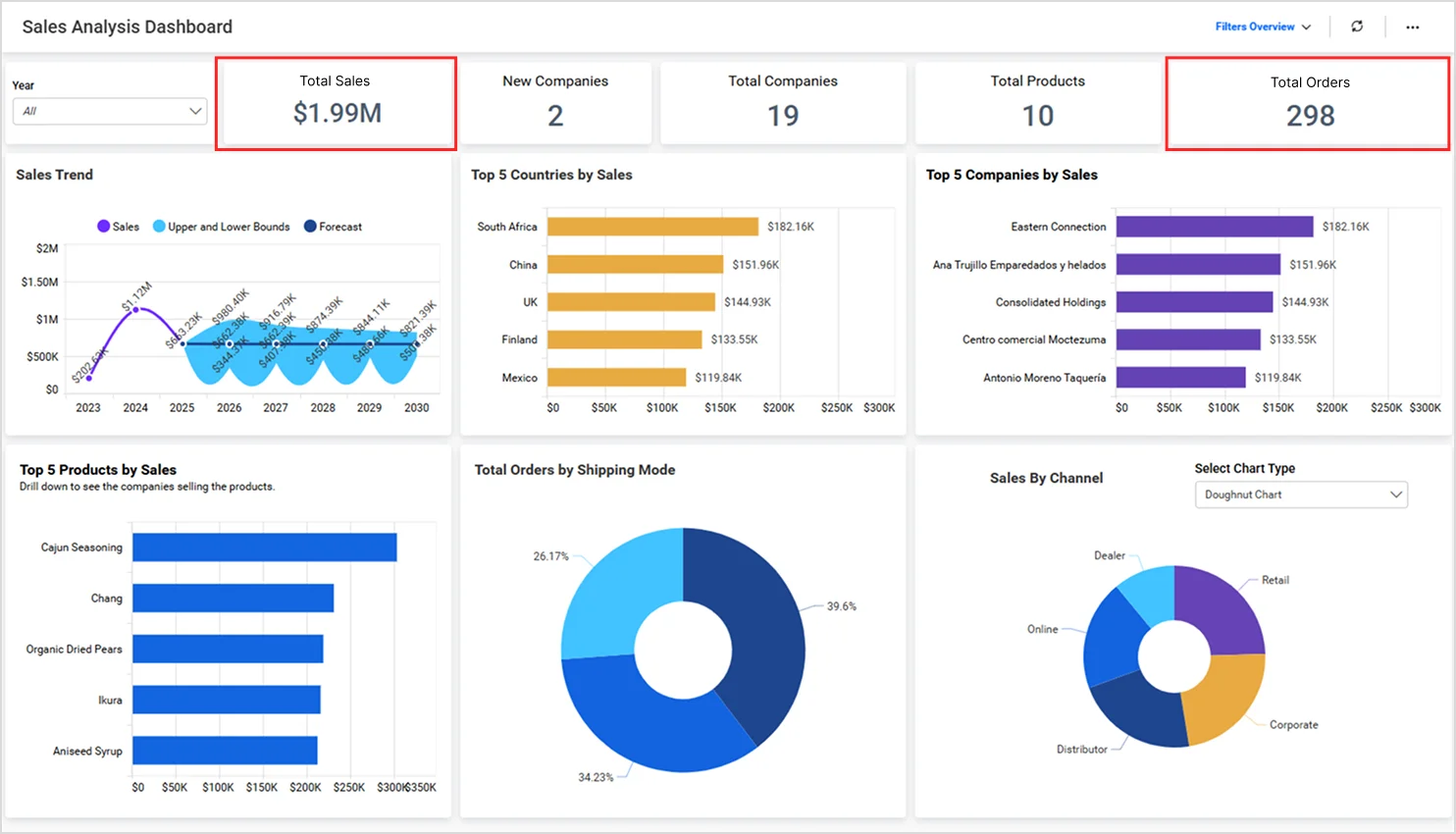
The difference in these numbers shows how enabling the Bold BI automatic refresh feature allows for real-time analysis and timely insights.
Enabling the automatic refresh feature allows for real-time analysis and timely insights.
Conclusion
With Bold BI, you gain the power to make confident decisions regarding key metrics and stay ahead of the competition. Ready to experience the impact of real-time analytics firsthand? Book a free, 30-minute, personalized demo and let our experts walk you through using the Bold BI features you’re most interested in. To explore the platform on your own, sign up for free trial.
Frequently asked questions
- 1.
What is real-time analytics?
Real-time analytics is the process of collecting, analyzing, and visualizing data as it is generated, enabling businesses to make immediate, data-driven decisions.
- 2.
How is real-time analytics different from traditional analytics?
Unlike traditional analytics, which relies on historical data, real-time analytics delivers up-to-date insights instantly, allowing faster responses to changing conditions.
- 3.
What are common use cases for real-time analytics?
Real-time analytics is commonly used for monitoring KPIs, detecting anomalies, tracking operational performance, and improving customer experiences.
- 4.
What challenges come with implementing real-time analytics?
Businesses often face challenges such as data overload, data accuracy issues, and the need to interpret fast-changing information effectively.
- 5.
How does Bold BI support real-time analytics?
Bold BI supports real-time analytics with live dashboard updates, automatic refresh, data alerts, embedded analytics, and extensive data connectivity options.