
BI Deployment Model Guide: Cloud, Private Cloud, On-Premises
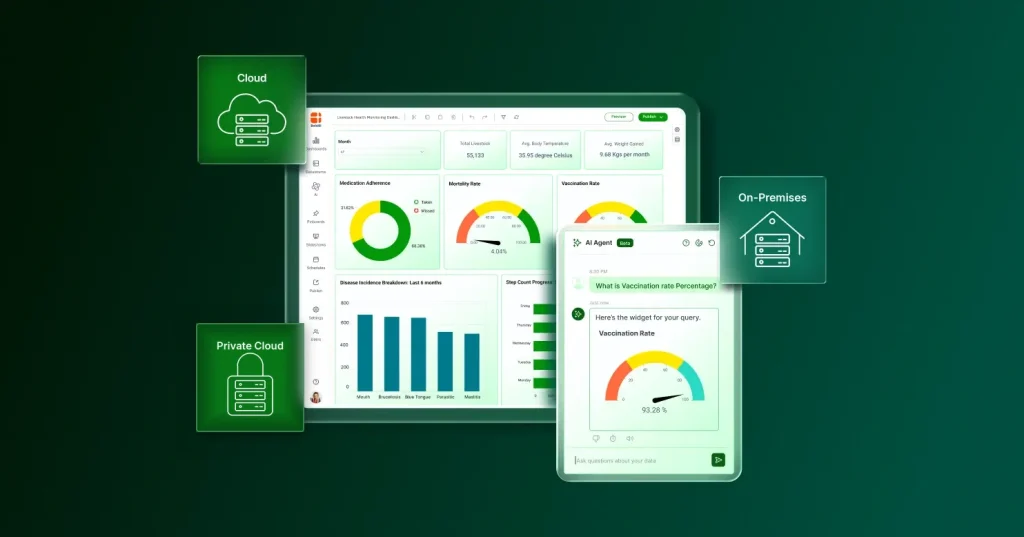
TL;DR: Choosing the right BI deployment model affects security, compliance, scalability, and operational responsibility. Whether you need the simplicity of a fully managed cloud environment, the isolation of dedicated private infrastructure, or complete control over self-hosted systems, Bold BI provides deployment options that align with your organization’s requirements.
Introduction
Every organization wants analytics that deliver timely insights, but not every organization has the same infrastructure, compliance, or security requirements. Some teams prioritize simplicity and speed, while others require dedicated environments or complete control over where their analytics platform runs.
As organizations modernize their analytics strategy, deployment decisions have become just as important as dashboarding capabilities. The deployment model you choose influences security, governance, scalability, maintenance, and operational ownership.
To address these varying requirements, Bold BI offers three deployment models: Cloud, managed private cloud, and on-premises. Each option delivers the same core analytics capabilities while supporting different levels of infrastructure control, isolation, and management responsibility.
Who this guide is for
This guide is for technical teams selecting, deploying, and managing BI platforms, especially when security, compliance, and scalability matter. It is particularly helpful for:
- IT managers responsible for governance and availability.
- DevOps engineers managing deployment and scaling.
- BI and data architects designing analytics environments.
With that context in mind, let’s explore the deployment options available in Bold BI and how each approach supports different business, security, and operational requirements.
Analytics deployment options in Bold BI
Modern enterprises rarely share identical infrastructure requirements. While some organizations prefer a fully managed analytics platform, others need dedicated environments or complete control over hosting and operations.
Bold BI supports three deployment models:
- Cloud deployment.
- Managed private cloud deployment.
- On-premises deployment.
Each delivers the same analytics, embedded BI, AI-powered insights, and multi-tenant capabilities. What differs is who manages the infrastructure and how isolated the environment is.
Cloud deployment: Fast, scalable, and fully managed
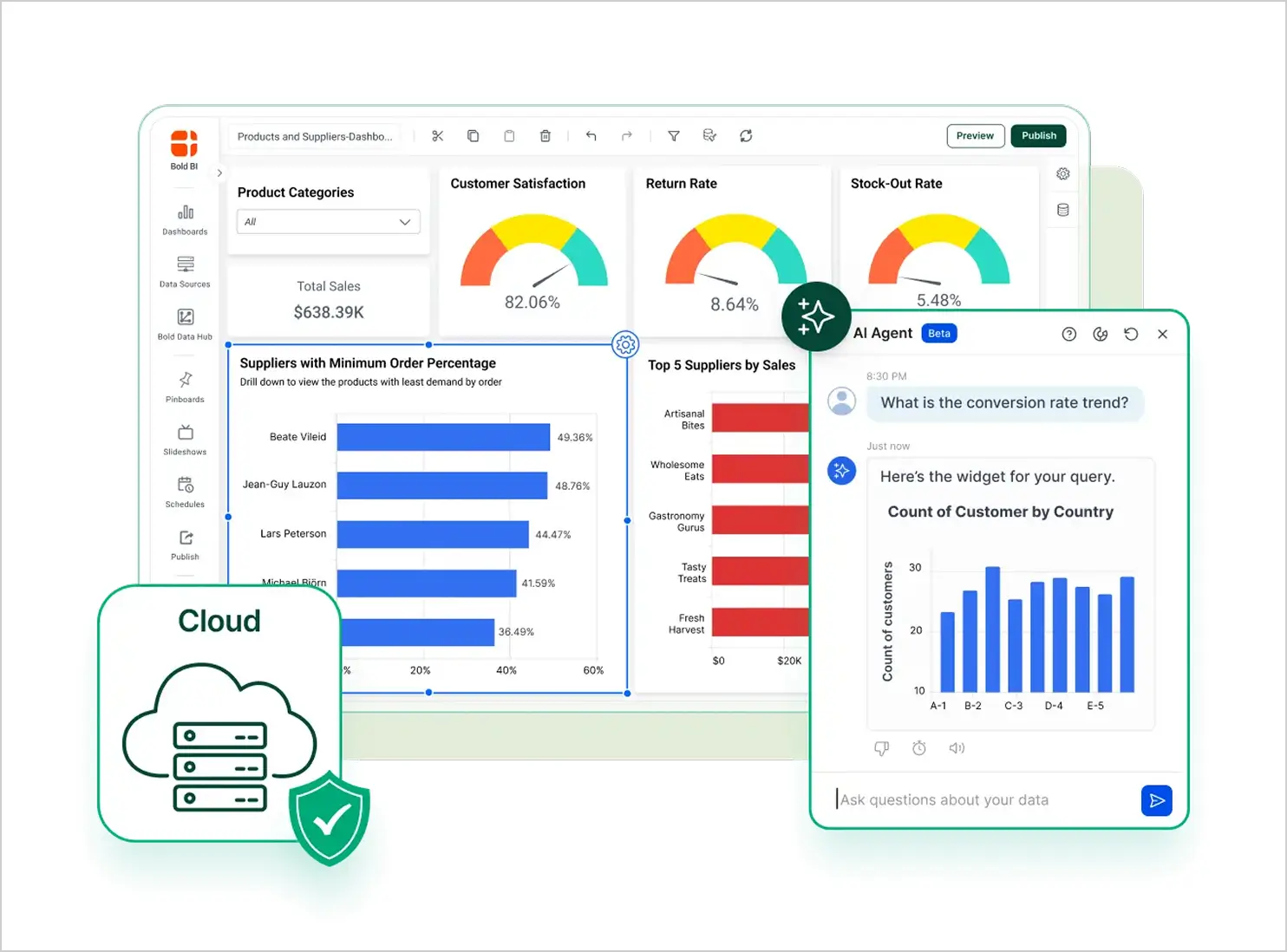
Cloud deployment provides a fully managed analytics environment hosted and operated by Bold BI. Organizations can focus on connecting data, building dashboards, and delivering insights without managing servers, updates, backups, or infrastructure scaling.
Key advantages
- Fast deployment with minimal infrastructure effort.
- Elastic scalability as users and workloads grow.
- Automatic updates, backups, and platform maintenance.
- Access to AI-powered analytics and real-time dashboards.
- Support for connections across cloud, SaaS, and on-premises data sources.
Recommended if
- You need a fast setup with minimal infrastructure lead time.
- You want a solution that grows with your business, especially if workloads are unpredictable or expected to change frequently.
- You prefer less IT work instead of managing servers, updates, and maintenance.
- Your team requires access from anywhere to support remote or distributed users.
Managed private cloud: Dedicated infrastructure without self-hosting
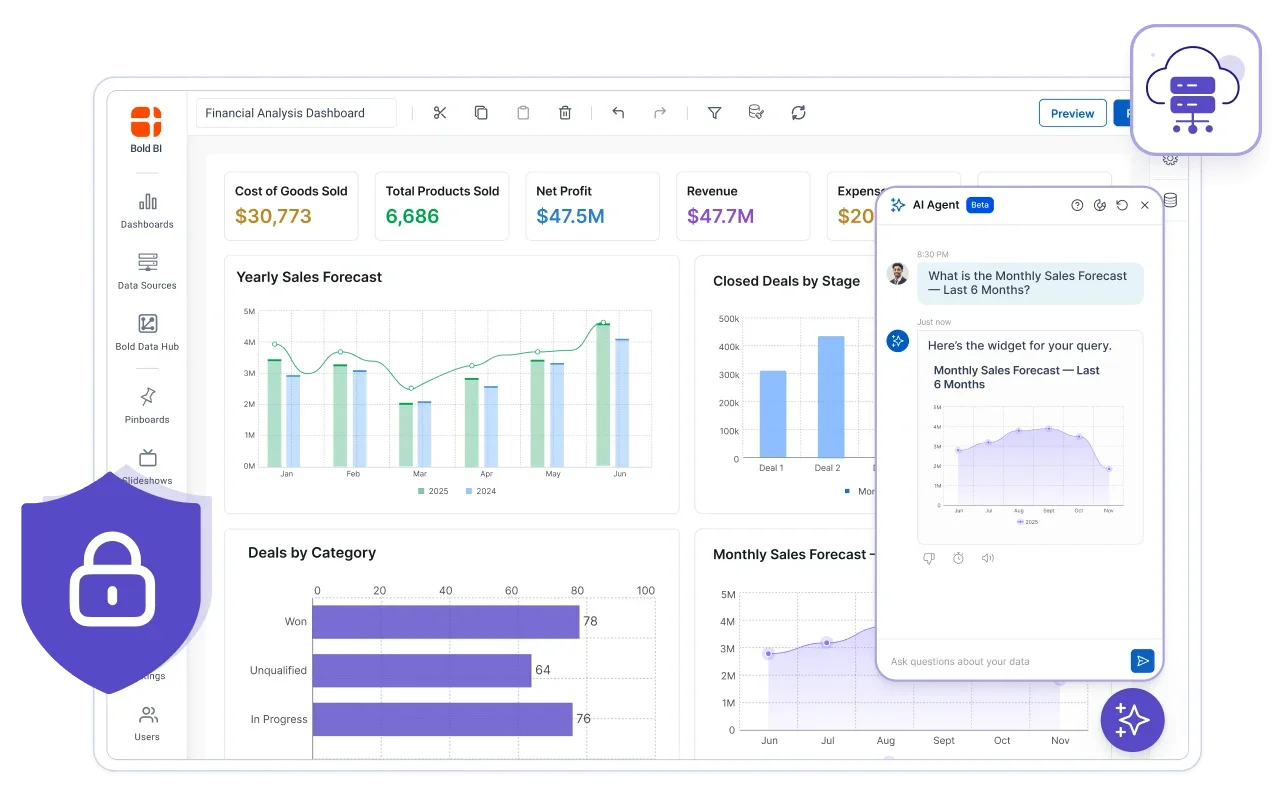
A managed private cloud deployment provides dedicated infrastructure that is exclusively allocated to your organization while still being fully operated and maintained by Bold BI. This approach combines the operational simplicity of a managed service with the additional isolation often required by security-conscious and regulated organiz
Key advantages
- Dedicated compute, database, storage, and network resources.
- Infrastructure isolated from other customers.
- Deployment in preferred regions to support data residency requirements.
- Private connectivity options such as VPN, VPC peering, and PrivateLink.
- Managed updates, monitoring, and operational support provided by Bold BI.
Recommended If
- Shared cloud environments do not meet your compliance requirements.
- Your organization requires dedicated infrastructure.
- You need stronger isolation without managing servers internally.
- Security reviews demand infrastructure-level separation and auditability.
On-premises deployment: Maximum control and governance
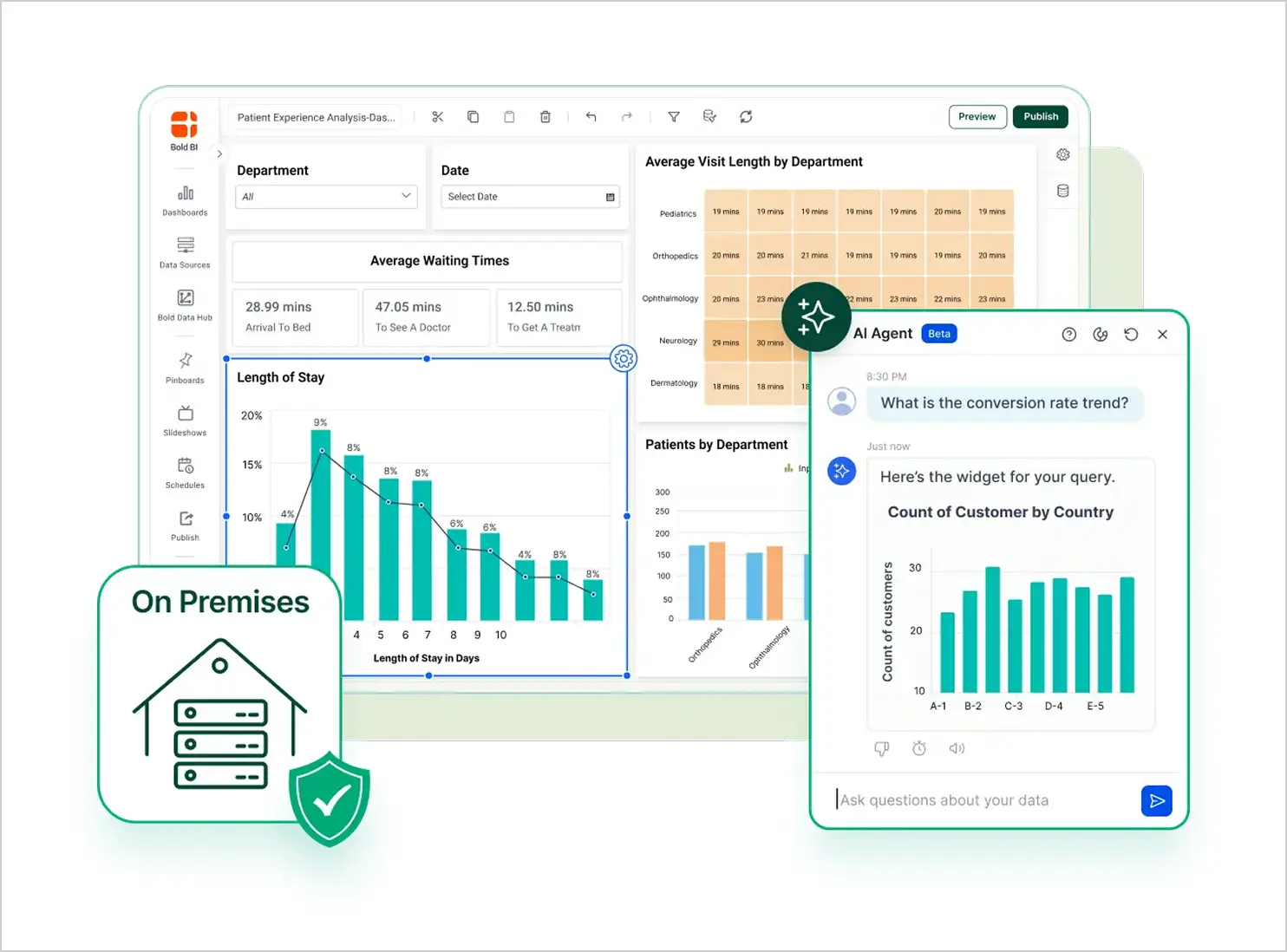
On-premises deployment model allows organizations to operate Bold BI within their own infrastructure. Teams can deploy on Windows, Linux, Docker, Kubernetes, or cloud virtual machines while maintaining full ownership of operational management, security configuration, and upgrade schedules.
Key advantages
- Internal deployment without vendor-hosted infrastructure: Run the platform inside your network boundary, with optional integrations based on your architecture.
- Full data ownership and flexibility: Deploy on your own servers for complete control, customization, and deployment flexibility.
- Security and access control: Options may include role-based access control, SSO integration, and encryption features to help meet your security policies.
- End-to-end analytics capabilities: Connect data, prepare it with built-in ETL, explore insights with AI, and easily export or embed dashboards.
Recommended if
- You require full control over deployment and hosting.
- You must align with internal governance or regulatory standards.
- Your organization has dedicated IT and DevOps capacity.
- You prefer managing update cycles internally.
To learn more about these Bold BI deployment options that give you flexibility to meet security, compliance, and infrastructure needs, refer to our documentation.
Cloud, private cloud, and on-premises BI: Side-by-side comparison
The following comparison table highlights the key differences between cloud, on-premises, and managed private cloud deployments to help you identify the approach that best fits your organization’s requirements.
| Criteria | Cloud | Managed private cloud | On-premises |
|---|---|---|---|
| Operated by | Bold BI | Bold BI | Your team |
| Infrastructure | Shared | Dedicated | Customer-owned |
| Setup speed | Fastest | Fast | Moderate |
| Isolation level | Shared environment | Dedicated environment | Full control |
| Upgrade management | Automatic | Scheduled with you | Customer managed |
| Data residency flexibility | Shared region | Preferred region | Customer environment |
| Infrastructure maintenance | Managed by Bold BI | Managed by Bold BI | Managed internally |
| Best for | Rapid deployment and scalability | Security-conscious organizations requiring dedicated infrastructure | Organizations requiring full infrastructure control |
If you are still deciding, the checklist below walks through the key questions in the same order that most IT and DevOps teams evaluate them.
How to choose the right BI deployment model
When selecting a deployment model, consider the following:
- Infrastructure ownership: Determine whether you want Bold BI to manage the environment or your team to operate it internally.
- Security and isolation requirements: Organizations with stricter security requirements may benefit from dedicated private infrastructure or self-hosted environments.
- Compliance and data residency: Evaluate where your data must reside and whether dedicated regional deployment or internal hosting is required.
- Operational resources: Consider whether your IT team has the time and expertise to manage infrastructure, upgrades, and monitoring.
- Scalability requirements: Assess expected growth in users, workloads, and analytics consumption over time.
Key takeaways
Choosing the right BI deployment model is ultimately about balancing operational responsibility, security requirements, infrastructure control, and compliance needs.
- Choose cloud when you want a fully managed analytics platform with minimal operational overhead and rapid scalability.
- Choose managed private cloud when you need dedicated infrastructure, stronger isolation, regional deployment flexibility, or enhanced compliance support while still benefiting from a fully managed service.
- Choose on-premises when complete control over infrastructure, security configurations, upgrades, and data residency is a top priority.
With Bold BI, organizations can deploy the same analytics platform across cloud, managed private cloud, and on-premises environments, enabling them to align analytics initiatives with their security, compliance, operational, and infrastructure requirements without sacrificing enterprise analytics capabilities.
Sign up for a free trial to evaluate Bold BI in your environment, explore pricing to find the plan that matches your team’s scale and infrastructure, or schedule a personalized demo to determine the best deployment approach for your organization. If you’d like a tailored recommendation, contact our team, and for faster setup across environments, check out our blog on Bold BI auto deployment on Windows, Linux, Kubernetes, and Docker to streamline installation, automate configuration, and accelerate deployment.
Frequently asked questions
-
- 1.
Which deployment option should I choose?
Choose cloud if you want the fastest deployment, minimal infrastructure management, and automatic maintenance. Choose managed private cloud if you need dedicated infrastructure and stronger isolation while still having Bold BI manage operations. Choose On-Premises if your organization requires complete control over hosting, security configurations, upgrades, and data residency.
- 2.
What is the difference between cloud and managed private cloud?
In the cloud deployment model, Bold BI runs your analytics environment on shared infrastructure managed by Bold BI. Managed private cloud provides dedicated compute, database, storage, and network resources exclusively for your organization while remaining fully managed by Bold BI.
- 3.
What is managed private cloud?
Managed private cloud is a deployment option that provides dedicated infrastructure operated by Bold BI. It is designed for organizations that require greater isolation, regional deployment flexibility, and enhanced compliance readiness without the operational burden of self-hosting.
- 4.
Which platforms and environments does Bold BI support for deployment?
Bold BI supports multiple deployment options to accommodate different infrastructure requirements. Cloud deployments are fully hosted and managed by Bold BI. Managed private cloud deployments run on dedicated infrastructure exclusively allocated to your organization and managed by Bold BI, with support for regional hosting and private connectivity options. On-premises deployments can be hosted on Windows and Linux servers, Docker containers, Kubernetes clusters, or virtual machines running on cloud providers such as AWS, Microsoft Azure, and Google Cloud, while remaining fully managed by your team.
- 5.
Is Bold BI secure across all deployment models?
Yes. Across cloud, managed private cloud, and on-premises deployments, Bold BI provides enterprise-grade security features such as role-based access control, SSO integrations, audit logging, encryption, and row-level security. Available controls may vary depending on deployment architecture and organizational requirements.
- 6.
Can I migrate between deployment models later?
Yes. Organizations can move between cloud, managed private cloud, and on-premises deployments as their infrastructure, compliance, or operational requirements evolve, allowing them to align analytics deployments with changing business needs.
- 7.
Which deployment model is best for regulated industries?
Organizations in highly regulated industries such as healthcare, financial services, and government often choose managed private cloud or on-premises deployments because they provide greater control over infrastructure isolation, data residency, and security requirements. The best option depends on your specific compliance obligations and operational preferences.
- 8.
Do all deployment models include the same analytics capabilities?
Yes. Bold BI delivers the same core analytics capabilities across cloud, managed private cloud, and on-premises deployments, including dashboards, embedded analytics, AI-powered insights, and multi-tenant support. The primary differences relate to infrastructure ownership, isolation, and operational management.
- 1.