Traditional BI vs. AI-Powered Analytics: Key Differences


 8 min read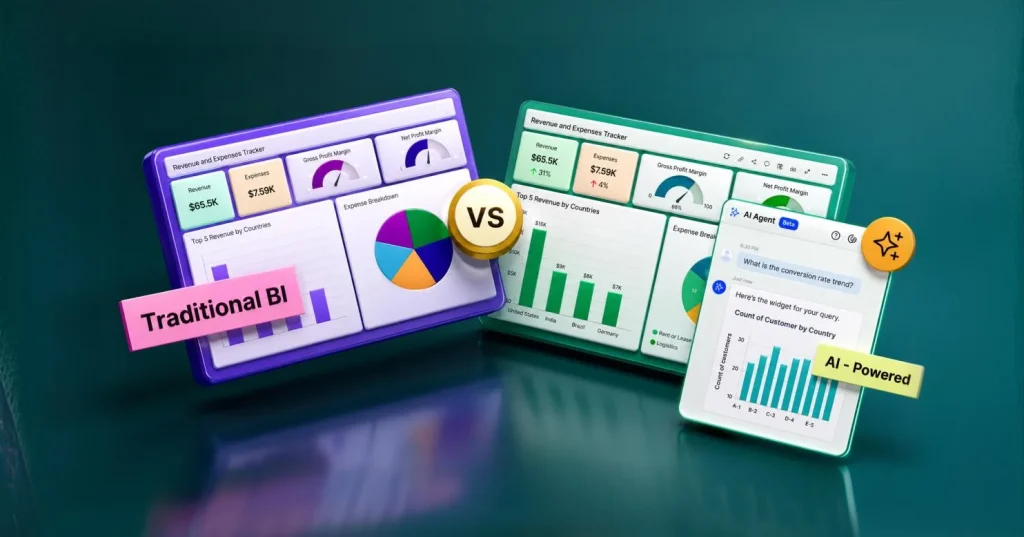
TL;DR: Traditional BI focuses on historical reporting using dashboards and manual analysis, while AI-powered analytics delivers real-time insights, automation, and predictive intelligence through machine learning and natural language processing. Organizations choosing between the two must evaluate their need for speed, scalability, automation, and advanced decision-making capabilities.
Introduction
Many organizations still rely on dashboards and manually prepared analysis to guide business decisions. While traditional BI platforms have helped standardize how data is structured and understood, identifying changes in performance or answering new questions often takes time and analyst effort. Today, businesses expect faster answers, easier data exploration, and systems that can highlight what matters without manual intervention. This shift is driving adoption of AI-powered analytics, which extends traditional BI with faster insights, natural language interaction, and more proactive decision support.
In this blog, we compare traditional BI and AI-powered analytics to help you understand what’s changing and how modern analytics platforms support faster, more accessible decision-making.
What Is Traditional BI?
Traditional business intelligence (BI) focuses on governed dashboards, historical analysis, structured data, and predefined queries. Users rely on dashboards and scheduled data to review past performance.
When to Use Traditional BI
Choose traditional BI when:
- Your focus is on historical analysis.
- Data sources are structured and stable.
- You have dedicated BI teams or analysts.
- Real-time insights are not critical.
- You need standardized dashboards.
Benefits of Traditional BI
Here’s how traditional BI helps organizations:
- Reliable insights: Consistent dashboards and repeatable data views for dependable decision-making.
- Strong governance: Controlled access, compliance support, and centralized data management.
- Mature ecosystem: Established tools, workflows, and organizational adoption.
- Standardized metrics: Shared KPIs and definitions across teams.
Real-World Scenario: Financial Analysis and Compliance
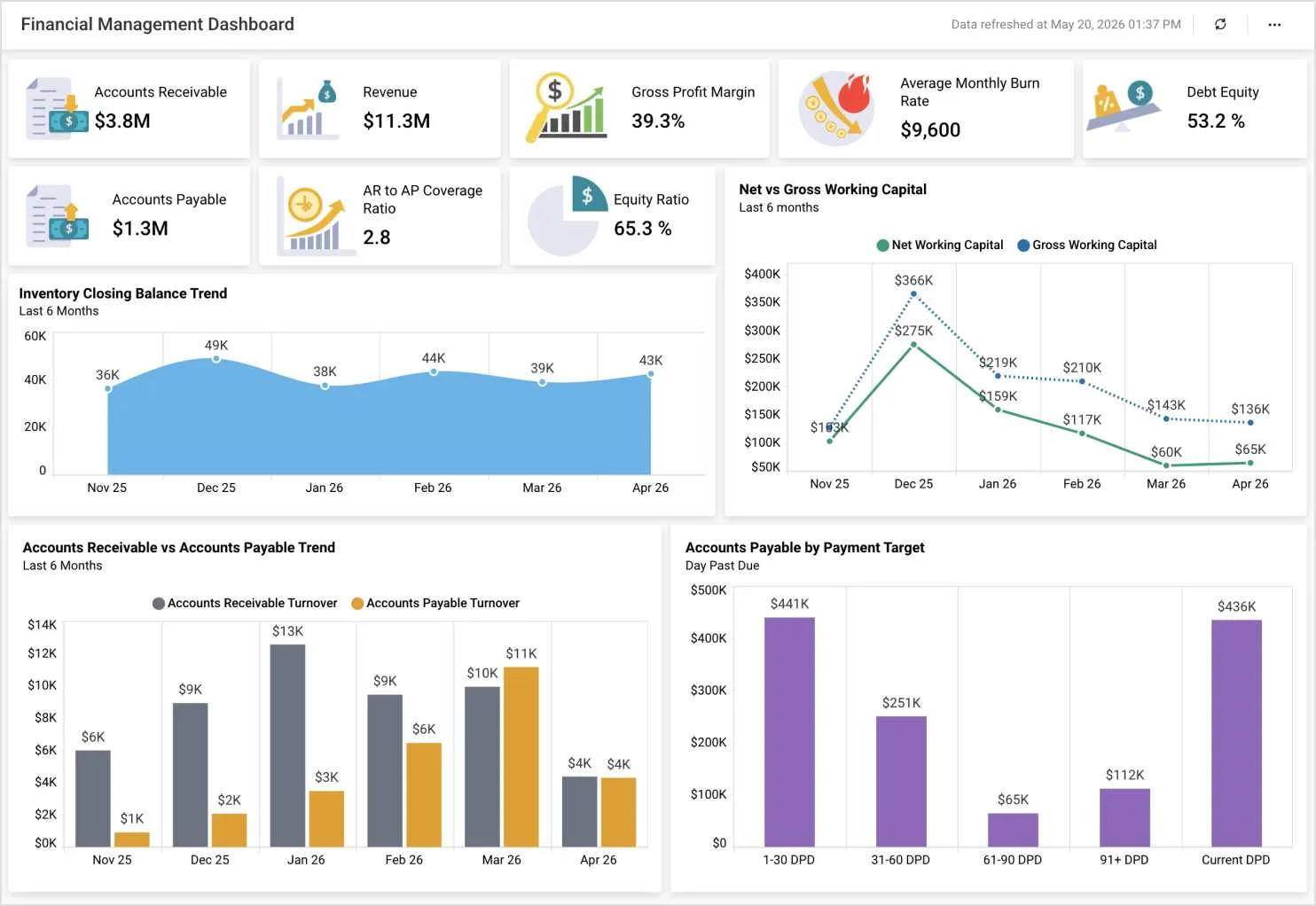
A large enterprise uses traditional BI to manage its financial analysis and compliance processes. Finance teams rely on structured data from ERP systems to maintain a consistent and governed view of organizational performance.
Using traditional BI tools:
- Predefined dashboards provide clear visibility into revenue, expenses, and profit margins across business units.
- Standardized data models ensure consistency and accuracy across all financial metrics.
- Data governance controls maintain data integrity and support regulatory compliance requirements.
- Historical analysis allows finance teams to compare performance across quarters and years.
This approach enables the organization to maintain high data integrity, strong governance, and consistent financial visibility, supporting confident decision-making based on trusted, structured data.
What Is AI-Powered Analytics?
AI-powered analytics applies machine learning and natural language processing to automate insight discovery, forecasting, anomaly detection, and natural-language.
Users can interact with data conversationally, generate insights instantly, and automate workflows without deep technical expertise.
When to Use AI-Powered Analytics
Choose AI-powered analytics when:
- You need real-time insights and predictions.
- You want to automate analytics workflows.
- Business users require self-service capabilities.
- Data volumes are large and complex.
- Faster decision-making is critical.
Benefits of AI-Powered Analytics
Here’s how AI-powered analytics benefits organizations:
- Faster decision-making: Processes large volumes of data quickly, enabling real-time insights and quicker business responses.
- Improved consistency: Automates repetitive analysis steps and reduces manual errors in analytics workflows.
- Predictive capabilities: Anticipates future trends, customer behavior, and potential risks.
- Automation of tasks: Eliminates repetitive manual analysis, freeing up time for strategic work.
- Deeper insights: Can surface non-obvious patterns that are difficult to detect with manual exploration alone.
- Personalization: Enables tailored customer experiences through intelligent segmentation and recommendations.
- Scalability: Can handle growing amounts of data without a proportional increase in resources.
Real-World Scenario: Sales Analytics Transformation
A sales organization may rely on traditional BI dashboards to review sales performance through manually generated dashboards. Because analytics is periodic and largely manual, identifying sales trends, regional performance changes, and product demand shifts often takes time, limiting the organization’s ability to respond quickly to changing market conditions.
By adopting AI-powered analytics capabilities similar to those demonstrated in Bold BI® sales dashboards:
- Real-time dashboards provide instant visibility into revenue, sales targets, regional performance, and product trends.
- Conversational analytics allows managers to ask business questions in natural language and instantly explore actionable insights.
- Automated insights and smart narrations highlight top-performing regions, products, and sales opportunities without requiring manual analysis.
This transformation enables the organization to shift from delayed, dashboard-based analysis to faster, AI-driven decision-making. With real-time visibility, intelligent forecasting, and automated insights, sales teams can respond proactively to market changes and improve overall revenue performance.
This real-world application highlights how AI-powered analytics platforms like Bold BI help organizations transform complex business data into clear and actionable insights.
Traditional BI vs. AI-Powered Analytics: Key Differences
The table below compares traditional BI and AI-powered analytics across analytics, automation, scalability, and decision support.
| Feature | Traditional BI | AI-Powered Analytics |
| Dashboard Creation | Manual setup | Prompt-based generation (faster) |
| Data Exploration | Filter-driven | Conversational |
| Insight Discovery | User-led | AI-assisted |
| Effort Required | High | Reduced |
| Accessibility | Analyst-led | Business-friendly |
| Alerts | Static thresholds | Intelligent alerts |
| Time to Insight | Slower | Faster |
| Decision Support | Historical | Proactive |
Best Practices for Choosing Between Traditional BI and AI-Powered Analytics
When deciding between traditional BI and AI-powered analytics, follow these best practices:
- Align with decision speed needs: Use AI-powered analytics when real-time or faster insights are critical for your operations.
- Prioritize user accessibility: Choose solutions that enable both technical and non-technical users to easily explore and understand data.
- Assess your infrastructure readiness: Leverage traditional BI for stable environments, but plan upgrades if adopting AI-powered capabilities.
- Evaluate cost vs. long-term value: Balance lower upfront costs of traditional BI with the long-term efficiency and ROI of AI-driven automation.
- Plan for scalability: Select a solution that can handle increasing data volumes and evolving analytics requirements.
Organizations following these practices often prefer platforms that combine automation, conversational analytics, and embedded intelligence, capabilities that solutions like Bold BI are designed to deliver.
How Bold BI Empowers Organizations with AI-Driven Analytics
Bold BI helps organizations adopt AI-powered analytics by adding powerful AI features to their existing workflows. Here are some key capabilities:
- Unified AI Agent: Business users can explore dashboards conversationally without depending on analysts or manually configuring filters.
- AI Copilot: Create and customize charts and dashboards using simple natural language, with minimal technical expertise.
- AI Agent for dashboards: Ask questions in natural language and get answers as text, visuals, and comparisons.
- Smart Narrations: Automatically generates simple explanations to help users understand data faster.
- Embedded AI: Easily integrate AI analytics into your own apps using APIs and SDKs with full customization.
- Prompt-to-Dashboard: Teams can generate dashboards faster using natural language prompts, reducing dashboard development time and accelerating analytics.
Modern AI-powered analytics platforms also allow organizations to embed conversational AI capabilities directly into dashboards and business applications, improving accessibility and decision-making across teams.
Final Thoughts
Traditional BI established the foundation for data-driven decisions, but it falls short in meeting today’s dynamic business needs. AI-powered analytics enhances this foundation with real-time insights, automation, and predictive capabilities. By combining AI with embedded and self-service BI, organizations can reduce manual effort and improve agility. Bold BI® enables this transformation, helping businesses build smarter, scalable analytics environments for the future.
With AI-powered analytics, enterprise dashboards, conversational BI, and scalable business intelligence capabilities, Bold BI helps organizations build smarter and more efficient analytics experiences for 2026 and beyond.
If you’re ready to explore AI-powered analytics:
- Start a free trial (no credit card required).
- Book a 30-minute live demo to see Bold BI’s AI features.
- Explore our documentation to learn how to configure AI in your application.
- Explore pricing plans tailored to your business needs.
Whether you are new to Bold BI or looking to expand your existing analytics experience, you can get started quickly with flexible deployment options and a smooth onboarding experience.
Related Resources:
- Agentic Analytics for Mid-Market Companies: Why It Matters
- AI for Data Analytics: Benefits, Best Practices & Use Cases
- How to Activate AI Assistant in Your Analytics Embedded App
- What is AI Analytics? Why It Matters & 4 Industry Use Cases
- How to Embed AI Assistant in Your Software Application
Frequently Asked Questions
- 1.
What is the main difference between traditional BI and AI analytics?
Traditional BI focuses on historical data, while AI analytics provides predictive and real-time insights.
- 2.
Is AI-powered analytics replacing traditional BI?
Not entirely. Many organizations combine both approaches for optimal results.
- 3.
Who benefits most from AI-powered analytics?
Businesses that need faster, data-driven decisions and automation benefit the most.
- 4.
Can small businesses use AI-powered analytics?
Modern platforms offer scalable and cost-effective AI solutions for businesses of all sizes.
- 5.
How does AI improve business intelligence?
AI enhances BI by automating insights, enabling predictions, and improving accessibility through natural language queries.