
Bold BI vs. Zoho Analytics: Which BI Platform Scales Better
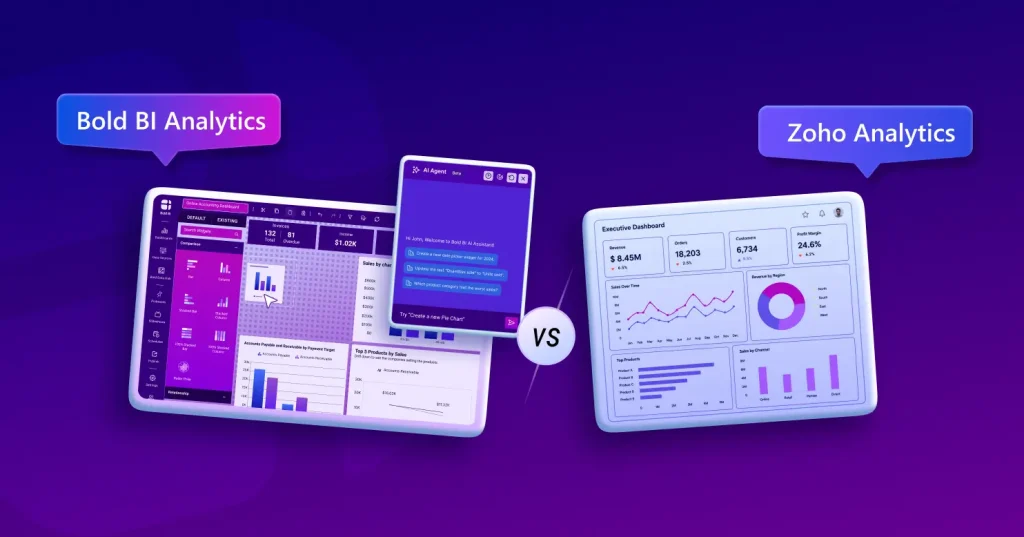
TL;DR: When comparing Bold BI® vs. Zoho Analytics for scalability, Bold BI is generally the stronger choice for organizations planning to scale embedded analytics, multi-tenant deployments, customer-facing dashboards, and SaaS products.
Many organizations begin their analytics journey with internal dashboards and operational analytics. As analytics adoption grows, however, organizations often need to extend insights beyond internal users and deliver analytics directly to customers, partners, and external stakeholders through SaaS applications, customer portals, and digital products.
This evolution introduces new challenges. Teams must support larger user bases, maintain governance and security controls, manage multiple customer environments, and provide analytics experiences that feel native to their products. As a result, scalability becomes just as important as dashboard functionality.
This is why many organizations compare Bold BI and Zoho Analytics. Both platforms offer modern business intelligence capabilities, including interactive dashboards, AI-assisted analytics, and extensive data connectivity. However, they differ in how they approach embedded analytics, customization, multi-tenancy, deployment flexibility, and long-term scalability.
Bold BI is also frequently evaluated alongside other major platforms, including Tableau, Power BI, Qlik Sense, and Sisense. See how it compares to Tableau and Power BI.
In this comparison, we’ll examine where each platform excels, explore key differences, and help you determine which solution best aligns with your analytics strategy and future growth plans.
What Does BI Platform Scalability Actually Mean?
When organizations evaluate BI platforms, scalability is often reduced to a single question: Can the platform handle more data?
In practice, BI platform scalability is much broader. A platform that performs well for a team of 20 internal users may not be the right fit once analytics must serve hundreds of customers, support multiple tenants, meet compliance requirements, or integrate directly into a SaaS application.
True BI platform scalability involves several dimensions:
- Supporting larger and more complex data environments
- Managing growing numbers of internal and external users
- Delivering customer-facing analytics securely across multiple tenants
- Maintaining performance as dashboard usage increases
- Supporting branding, customization, and embedded analytics requirements
- Adapting to evolving deployment, compliance, and infrastructure needs
- Controlling costs as analytics adoption expands
Organizations rarely outgrow analytics because they need more charts. They outgrow platforms when governance, deployment, user management, and customer-facing requirements become significantly more complex.
The eight factors below provide a practical framework for evaluating how well Bold BI and Zoho Analytics support analytics initiatives as they scale.
8 Factors to Evaluate Before Scaling Your Analytics Platform
Scalability rarely comes down to whether a platform can handle more data. A tool that works well for internal analytics doesn’t automatically support analytics delivered to customers, partners, or a growing product. Before migrating or scaling, these eight factors help determine how much effort is involved and whether a platform will hold up long term.
Analytics and Dashboard Complexity
Consider how much rebuilding is involved when recreating existing analytics and dashboards on a new platform:
- Recreating calculated fields, joins, and custom formulas in a different designer
- Rebuilding cross-tab, pivot, and drill-through views for a new layout engine
- Auditing embedded views for their closest equivalent on the new platform
- Retesting filters and parameters that drove interactivity in the original dashboards
A dashboard that looks simple can hide several blended tables underneath. Testing the five most-used dashboards, not the simplest ones, gives the most honest read on migration effort.
Data Source and Integration Range
Evaluate how well a platform connects to the full range of data an organization uses:
- Coverage for the databases, data warehouses, and cloud services already in use
- Support for API-based feeds outside any single vendor ecosystem
- Refresh schedules and credential management for every data source
- Ability to consolidate multiple department-specific sources into one shared data model
Teams built around a single ecosystem often underestimate how many of their sources are tied to it. Mapping every current source against a new platform’s connector list upfront avoids surprises mid-project.
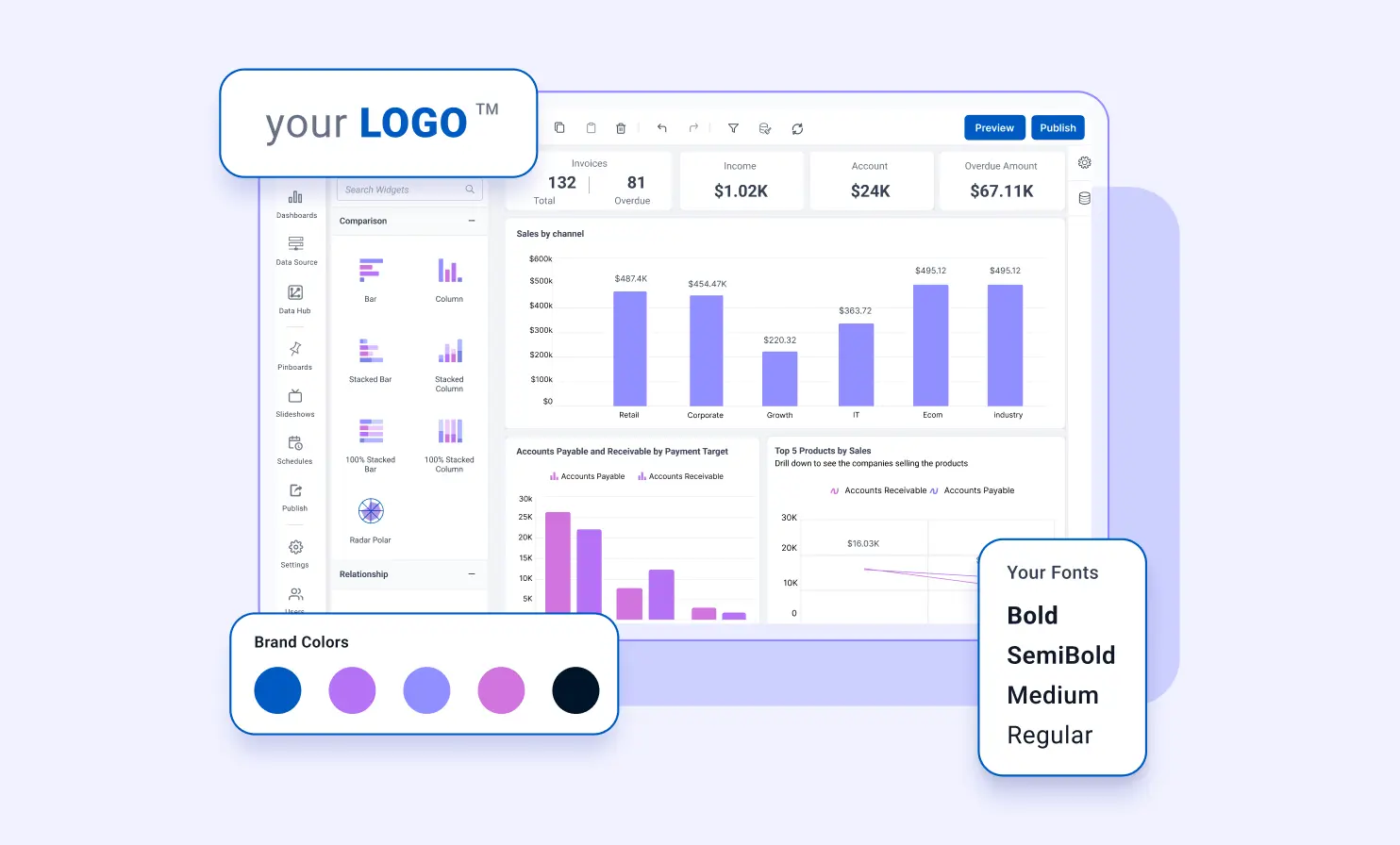
Customization and White-Label Depth
Internal dashboards rarely need to match a brand’s look and feel. Customer-facing analytics does. Consider:
- How much of the dashboard UI can carry a company’s own branding, not the platform’s
- Support for custom themes, layouts, and navigation
- Availability of custom domains, logos, and a fully white-labeled experience
- Limits on what can be restyled versus what’s fixed by the platform
Branding requirements are easy to underestimate until a customer asks why the analytics screen looks like a different product. Listing every “must look like us” requirement before evaluating a platform avoids that conversation happening after signing a contract.
Learning Curve and Implementation Effort
A platform built for self-service exploration, and one built for embedding into a product require different things of the implementing team. Weighing the learning curve means:
- Estimating ramp-up time for developers working with APIs, SDKs, and embedding frameworks
- Accounting for how fluent internal teams already are with the current tool
- Budgeting time for a proof-of-concept before committing to a full rollout
- Identifying whether the implementation work sits with technical teams, non-technical teams, or both
A platform can be easy to use and still take real time to implement well, especially when embedding is new to the team. A short pilot project is a more reliable estimate than a sales demo.
User Growth: Internal Teams vs. Customer-Facing Scale
Consider whether the platform’s permission model can grow from internal use to external, customer-facing delivery:
- Support for permission structures built around tenants or accounts, not just internal roles
- Row-level security on a per-customer basis
- How provisioning scales as external users are added
- Embedding flows that can be tested and configured separately for each destination app or portal
Internal analytics and customer-facing analytics behave like different products, even on the same data. If external users are anywhere on the roadmap, design permissions for that scale now rather than retrofitting later.
Deployment and Infrastructure Flexibility
Evaluate how much deployment flexibility a platform offers as infrastructure or compliance needs diversify:
- Options across cloud, on-premises, and containerized deployment
- Support for Docker, Kubernetes, or Azure App Service where internal standards require it
- Ability to meet hosting and compliance needs for new customer segments or regions
- Time required for environment setup beyond a single managed cloud
A single managed cloud environment is easy to administer, but it can narrow deployment options as needs diversify. Organizations planning enterprise or OEM deployments should map infrastructure requirements before choosing a platform, not after.
Pricing as Usage Scales
List pricing rarely tells the full cost story once usage grows beyond a single internal team. Before comparing rate cards, it helps to model:
- How costs shift as user counts move from internal teams to hundreds or thousands of end customers
- Whether the pricing model is per-user, per-viewer, or usage-based, and how that scales with adoption
- What embedding, white-labeling, or multi-tenant deployment adds to the total cost
- Administrative or implementation costs that don’t show up on a pricing page
Always model total cost at expected future scale, not today’s headcount, and confirm current pricing directly with any vendor under evaluation.
Weighing these eight factors gives a more honest read on scalability than a feature checklist alone, and it’s exactly the evaluation worth doing before committing to any analytics platform long-term.
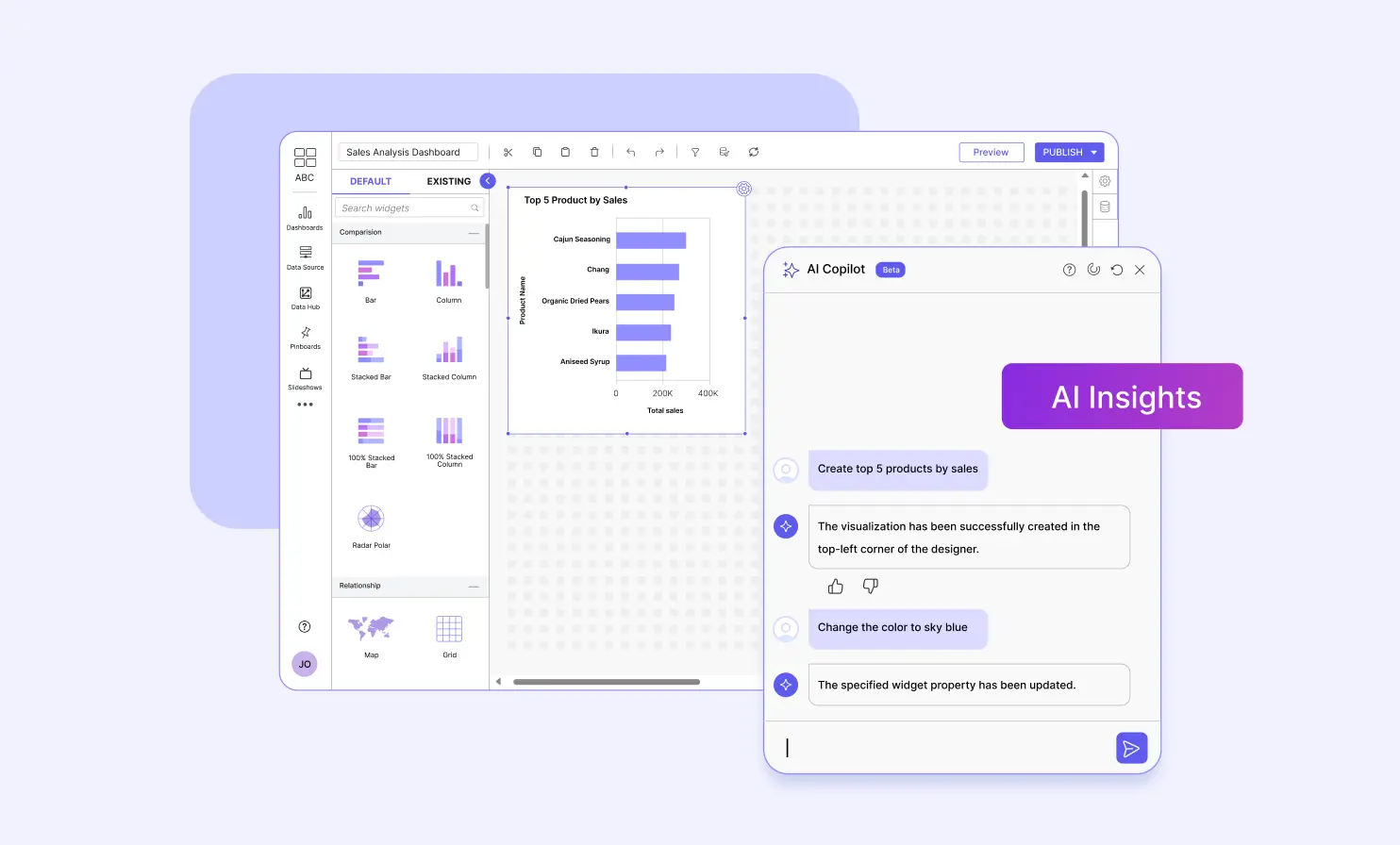
AI and Automation Capabilities
Consider how much of the analytics workflow AI can take off a team’s plate as usage grows beyond what a small group can manually build and maintain:
- Whether dashboards and charts can be generated from plain-language requests, not just point-and-click builders
- Whether the platform explains why a metric changed, not just that it changed
- Support for natural-language querying by non-technical business users
- Forecasting, anomaly detection, or other predictive capabilities built into the platform
As dashboard volume and user counts grow, AI-assisted analysis becomes a practical way to keep insight generation from bottlenecking on a small analytics team. Testing how each platform’s AI features perform against your own data — not a vendor demo dataset — gives the clearest read on real-world value.
Next, let’s take a closer look at each platform and the audiences they serve.
Bold BI Overview
Bold BI is an enterprise-grade business intelligence and embedded analytics platform designed to help organizations integrate analytics directly into applications, customer portals, and SaaS products.
Rather than treating analytics as a separate destination, Bold BI lets organizations deliver data experiences within the tools and environments their users already employ. Its support for embedded analytics, white-label customization, multi-tenant architectures, and flexible deployment models makes it a consideration for organizations building analytics into customer-facing products and services.
Ideal for
- SaaS companies
- Independent Software Vendors (ISVs)
- Software product teams
- Customer-facing analytics initiatives
- Enterprise analytics deployments
Organizations that want analytics to be a core part of their product experience often evaluate Bold BI for its flexibility, customization, and deployment options.
Explore a live Bold BI demo to see embedded analytics in action.
Zoho Analytics Overview
Zoho Analytics is a self-service business intelligence platform that helps organizations analyze data through dashboards, visualizations, and analytics workflows.
The platform is commonly evaluated by organizations that want business users to explore data independently and by teams already leveraging applications within the Zoho ecosystem. Its focus on usability and broad business application integrations makes it suitable for a variety of internal analytics scenarios.
Ideal for
- Business users and internal analytics teams
- Business analysts
- Small and mid-sized businesses
- Organizations already using Zoho applications
- Sales, marketing, finance, HR, customer support, and other department-level analytics initiatives
To establish a high-level comparison, let’s examine how both platforms align across the key capabilities organizations commonly evaluate.
Next, let’s explore the areas where the two platforms take different approaches.
Bold BI vs. Zoho Analytics Across 8 Scalability Factors
While both platforms share many analytics capabilities, they differ in how they approach embedded analytics, customization, multi-tenancy, deployment flexibility, governance, and long-term scalability. Understanding these differences can help organizations determine which platform best aligns with their business objectives and future growth plans.
The following sections examine each platform across key evaluation areas that commonly influence analytics platform selection.
Analytics & Dashboard Complexity
As analytics initiatives grow, dashboards often become more complex. Organizations may need to manage larger datasets, more data sources, advanced calculations, customer-specific views, and increasingly sophisticated analytics requirements.
Bold BI
Bold BI is designed to support embedded analytics and customer-facing analytics environments, where dashboards often need to serve multiple user groups while maintaining governance and access controls. Organizations delivering analytics through SaaS applications, customer portals, or software products can scale dashboard experiences while maintaining consistent user experiences across customers and tenants.
Zoho Analytics
Zoho Analytics supports interactive dashboards, advanced analytics, and self-service analytics. Organizations evaluating migration projects should assess the effort required to recreate existing dashboards, calculations, formulas, and analytics workflows when moving between platforms.
Scalability takeaway
Organizations expecting increasingly complex embedded analytics or customer-facing analytics deployments may find Bold BI better aligned with long-term scalability requirements.
Data Source & Integration Range
Data requirements typically expand alongside analytics adoption. As organizations grow, they often need to consolidate information from databases, cloud platforms, business applications, APIs, and data warehouses into a single analytics environment.
Bold BI
Bold BI supports connectivity across relational databases, APIs, cloud services, enterprise applications, data warehouses, BigQuery, Snowflake, and other business systems. This flexibility allows organizations to build analytics environments that incorporate data from multiple business functions and technologies.
Zoho Analytics
Zoho Analytics offers connectivity across databases, cloud platforms, business applications, data warehouses, and the broader Zoho ecosystem. Organizations already using Zoho applications may benefit from streamlined access to business data across those systems.
Scalability takeaway
Both platforms provide extensive connectivity options. The best fit depends on the organization’s existing technology ecosystem and long-term integration strategy.
Customization & White-Label Depth
Customer-facing analytics often require dashboards to appear as a natural extension of the product rather than a separate third-party experience.
Bold BI
Bold BI supports extensive white-label customization, including custom branding, domain configuration, navigation control, theming, and OEM analytics requirements. Organizations can align analytics experiences with their existing products and customer experiences.
Zoho Analytics
Zoho Analytics provides branding, OEM deployment, and embedded analytics customization capabilities that support a variety of customer-facing analytics use cases.
Scalability takeaway
As customer-facing analytics initiatives grow, branding and customization requirements often become more important. Organizations building analytics into products may benefit from Bold BI’s customization flexibility.
Learning Curve & Implementation Effort
The effort required to deploy and scale analytics can vary depending on whether analytics is intended for internal business users or embedded directly into customer-facing applications.
Bold BI
Organizations implementing embedded analytics, multi-tenant deployments, and customer-facing analytics environments should anticipate additional planning and technical implementation efforts. These investments often support greater flexibility and control as analytics initiatives mature.
Zoho Analytics
Zoho Analytics emphasizes self-service analytics and ease of adoption for business users. Organizations focused primarily on internal analytics initiatives may find implementation and onboarding more straightforward.
Scalability takeaway
Zoho Analytics may support faster adoption for internal analytics initiatives, while Bold BI provides greater flexibility for organizations planning long-term embedded analytics deployments.
User Growth: Internal Teams vs. Customer-Facing Scale
One of the most important scalability considerations is whether analytics will remain internal or eventually be delivered to customers, partners, and external stakeholders.
Bold BI
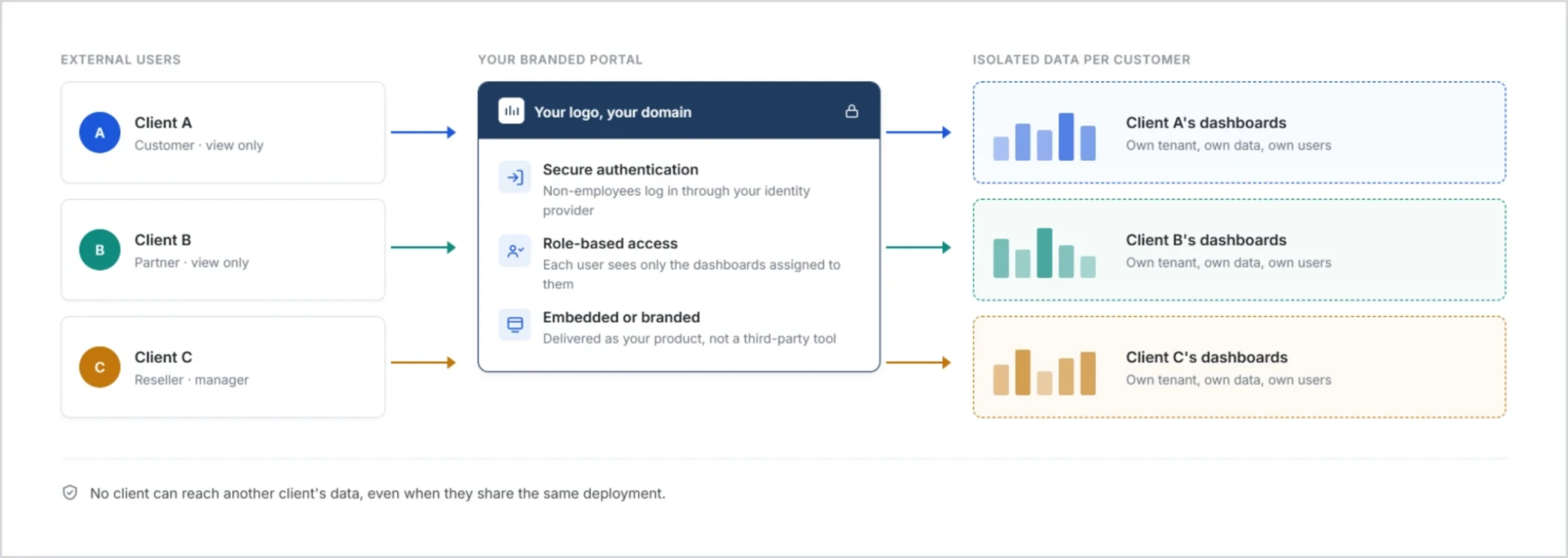
Bold BI includes capabilities that support embedded analytics, multi-tenancy, tenant isolation, row-level security, and customer-specific access controls. These capabilities help organizations deliver analytics across growing customer bases while maintaining governance and data separation requirements.
Zoho Analytics
Zoho Analytics offers a dedicated Embedded BI solution built for external, customer-facing delivery, including multi-tenant data isolation, row-level security, and sharing and permissions controls. Organizations evaluating long-term customer-facing scale should compare each platform’s tenant-isolation architecture, licensing model, and embedding depth against their specific SaaS or ISV roadmap.
Scalability takeaway
Both platforms offer multi-tenancy and row-level security for customer-facing delivery. Organizations planning large-scale embedded or OEM analytics deployments will generally find Bold BI’s licensing model and deployment flexibility better aligned with that scale, while Zoho Analytics is a strong fit for teams already standardized on the Zoho ecosystem.
Deployment & Infrastructure Flexibility
Deployment requirements often become more complex as analytics initiatives expand across departments, business units, customers, and geographic regions.
Bold BI
Bold BI supports cloud, on-premises, private cloud, Docker, Kubernetes, Windows, Linux, and Azure App Service deployments. This flexibility helps organizations align analytics with evolving infrastructure, compliance, and governance requirements.
Zoho Analytics
Zoho Analytics supports Zoho-hosted cloud, private cloud, public cloud, and on-premises deployment models. These options allow organizations to choose deployment approaches that match their operational requirements.
Scalability takeaway
Organizations with evolving infrastructure strategies, containerized environments, or specialized deployment requirements may find Bold BI’s deployment flexibility particularly valuable as analytics initiatives expand.
Pricing as Usage Scales
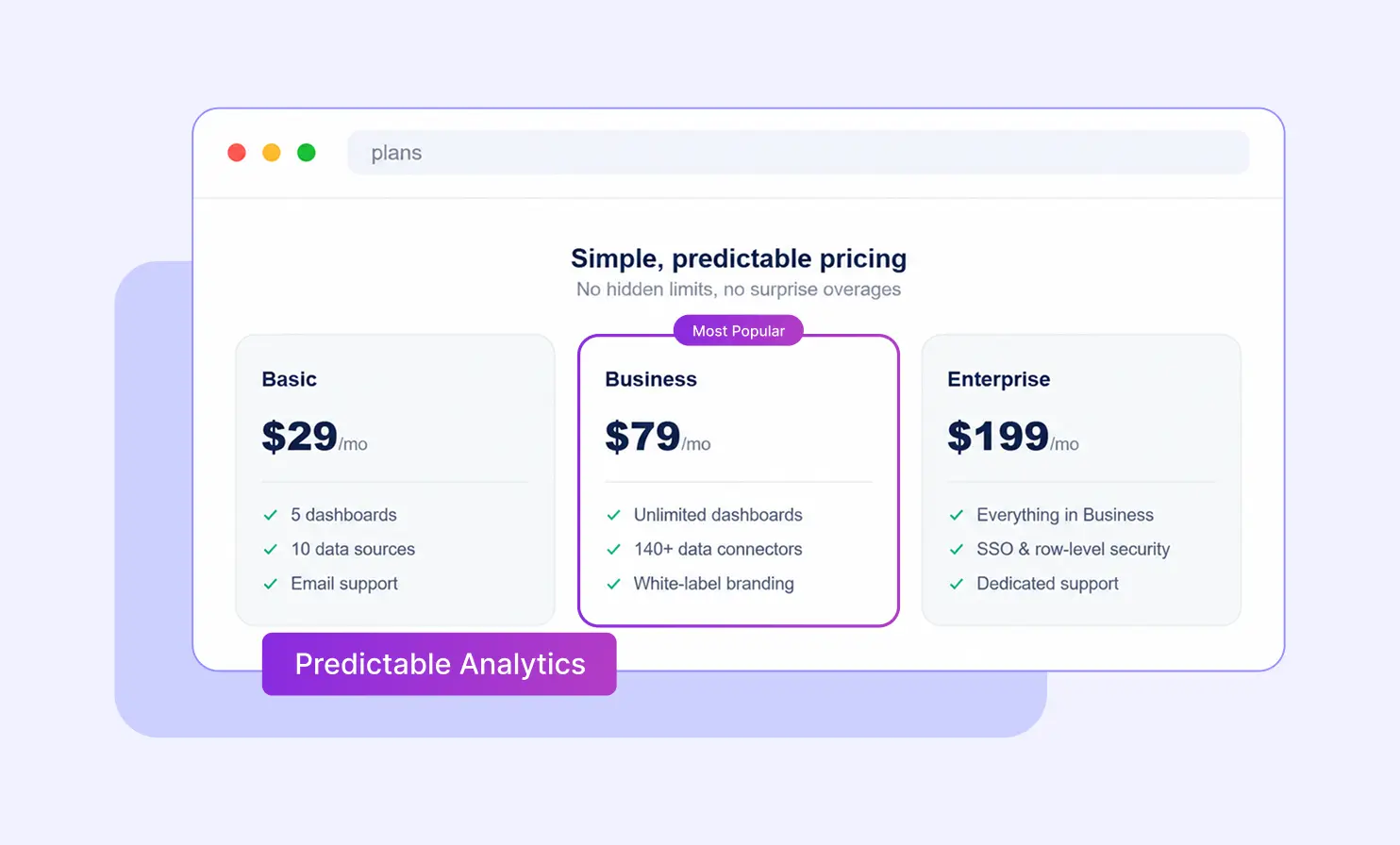
Pricing can influence scalability just as much as platform capabilities. Organizations should evaluate how licensing, administration, governance, and deployment costs may change as analytics adoption grows.
Bold BI
Bold BI pricing varies depending on deployment models, implementation requirements, user needs, and analytics delivery scenarios. Organizations should evaluate pricing based on expected usage, deployment requirements, and future growth plans.
Zoho Analytics
Zoho Analytics offers publicly available tier-based pricing that allows organizations to estimate costs as analytics adoption grows. Organizations should evaluate how future user growth and data requirements align with projected costs.
Scalability takeaway
The most effective pricing model depends on how analytics is expected to scale. Organizations should assess total cost of ownership based on future requirements rather than current usage alone.
AI and Automation Capabilities
As analytics scales to more users and more dashboards, AI-assisted features increasingly determine how much manual dashboard-building and monitoring a team must sustain.
Bold BI
Bold BI’s AI Analytics includes an AI Copilot and AI Agent for building and querying dashboards from plain-language requests, Smart Narrations that generate plain-language summaries of dashboard metrics and trends, and Prompt-to-Dashboard generation. These capabilities are embeddable into customer-facing applications via JavaScript SDKs and APIs.
Zoho Analytics
Zoho Analytics includes Ask Zia for natural-language querying and Zia Insights for automated pattern detection, along with predictive analytics, forecasting, and anomaly detection features built into the platform.
Scalability takeaway: Both platforms offer natural-language and automated-insight capabilities. Organizations planning to embed AI-assisted analytics directly into a customer-facing product may find Bold BI’s SDK-based embedding model better suited to that use case, while Zoho Analytics’ Ask Zia is well suited to internal, self-service exploration.
Bold BI vs. Zoho Analytics: Scored Across 8 Scalability Factors
Both Bold BI and Zoho Analytics offer a broad set of business intelligence and analytics capabilities. However, the platforms differ in how they approach embedded analytics, customization, deployment, governance, and analytics delivery. The table below summarizes how Bold BI and Zoho Analytics align across the eight scalability factors discussed throughout this article.
| Scalability Factor | Bold BI | Zoho Analytics |
| Analytics & Dashboard Complexity | Designed to support embedded analytics and customer-facing environments | Commonly used for self-service analytics and internal analytics |
| Data Source & Integration Range | Broad enterprise connectivity across databases, APIs, cloud services, and data warehouses | Broad connectivity across databases, cloud services, business applications, and the Zoho ecosystem. |
| Customization & White-Label Depth | Extensive white-label, OEM, branding, and customization capabilities | Branding and embedded analytics customization options available |
| Learning Curve & Implementation Effort | Often involves additional planning for embedded and customer-facing deployments | Frequently adopted for self-service analytics and business-user accessibility |
| User Growth & Customer-Facing Scale | Strong focus on embedded analytics, multi-tenancy, and customer-facing analytics delivery | Supports multi-tenant, customer-facing analytics with row-level security, tenant data isolation, and sharing/governance controls |
| Deployment & Infrastructure Flexibility | Depends on deployment model and analytics requirements | Cloud, private cloud, public cloud, and on-premises deployment options |
| Pricing as Usage Scales | Depends on deployment model and analytics requirements | Public tier-based pricing available |
| AI and Automation Capabilities | AI Copilot, AI Agent, and Smart Narrations built for embedding into customer-facing products | Ask Zia and Zia Insights built for self-service, natural-language exploration |
The Verdict: Which BI Platform Scales Better
If your primary goal is internal analytics, departmental analytics, and self-service business intelligence, Zoho Analytics remains a compelling option. Its usability, natural-language analytics capabilities, and ecosystem integrations make it attractive for organizations seeking easy access to data across business teams.
If your roadmap includes embedded analytics, customer portals, SaaS products, OEM deployments, multi-tenant architecture, or large-scale customer-facing analytics, Bold BI provides stronger scalability advantages. Its emphasis on white-labeling, governance, deployment flexibility, and embedded analytics enables organizations to scale analytics initiatives without redesigning their architecture as requirements evolve.
In short:
- Choose Zoho Analytics when scaling internal analytics.
- Choose Bold BI when scaling customer-facing analytics.
For organizations expecting analytics to become a core product feature rather than an internal analytics tool, Bold BI is generally the stronger long-term scalability choice.
When Zoho Analytics Is the Right Choice
While this comparison focuses on scalability, Zoho Analytics remains a strong business intelligence platform for many organizations.
Zoho Analytics may be the better choice for:
- Organizations already using Zoho CRM and other Zoho applications.
- Internal business intelligence initiatives.
- Department-level analytics.
- Business users seeking self-service analytics capabilities.
- Organizations prioritizing ease of adoption and rapid deployment.
For these scenarios, Zoho Analytics may provide the functionality required without the additional implementation considerations associated with large-scale embedded analytics environments.
Why Choose Bold BI for Your AI and Analytics Needs?
Organizations already using Zoho CRM, Zoho Books, or other Zoho applications may find Zoho Analytics appealing because of its native ecosystem integrations. However, analytics requirements often extend beyond internal analytics. For organizations evaluating embedded analytics, customer-facing dashboards, white-label customization, multi-tenant deployments, and flexible deployment options, Bold BI provides a scalable foundation for delivering analytics across products, customers, and teams.
- Embed analytics directly into applications, customer portals, and SaaS products with Embedded Analytics.
- Deliver branded analytics experiences through White-Label Analytics and OEM-ready customization.
- Support scalable customer-facing analytics with Multi-Tenancy.
- Accelerate decision-making with AI Analytics, including Smart Narration, conversational analytics, and forecasting.
- Connect data from multiple business systems using Data Hub and extensive integration options.
- Deploy analytics across cloud, on-premises, Docker, Kubernetes, and other environments with Flexible Deployment Options.
- Maintain enterprise-grade security through Security & Governance Capabilities.
Whether you’re delivering analytics to internal users, customers, or partners, Bold BI helps organizations scale analytics initiatives while maintaining flexibility, performance, and control.
One way to evaluate an analytics platform is to examine how organizations use it in real-world scenarios. The following example highlights how Backwind leveraged Bold BI to deliver embedded analytics within its SaaS application.
Real-World Use Case: How Backwind Embedded Real-Time Analytics with Bold BI
Beyond customer success stories, independent reviews can provide additional insight into implementation experiences, product usability, customer support, and overall business value.
Customer Reviews & Industry Recognition
Customer reviews and analyst evaluations can provide valuable insight into factors that extend beyond feature comparisons, including implementation experience, usability, support quality, and long-term business value.
Organizations evaluating analytics platforms often consult independent review platforms such as G2 to better understand real-world user experiences. These reviews can help teams assess:
- Ease of implementation
- Product usability
- Customer support quality
- Vendor responsiveness
- Embedded analytics capabilities
- Long-term platform value
Combining independent customer feedback with product capabilities allows organizations to make more informed analytics decisions.
Conclusion
Both platforms provide modern BI capabilities, but they scale in different ways. Zoho Analytics is well suited to organizations focused on self-service analytics and internal analytics, particularly those already invested in the Zoho ecosystem. Bold BI® is better aligned with organizations that need to scale embedded analytics, multi-tenant deployments, white-label experiences, and customer-facing analytics across products and applications.
As analytics becomes a larger part of digital products and business operations, selecting a platform that aligns with both current requirements and future plans is essential.
Ready to see embedded analytics in action? Start a free Bold BI trial or schedule a personalized demo to explore how analytics can be seamlessly integrated into your applications, customer portals, and SaaS products.
Frequently Asked Questions
- 1.
Is Bold BI a good alternative to Zoho Analytics?
Yes. Bold BI is a strong alternative for organizations that require embedded analytics, white-label dashboards, SaaS analytics, and flexible deployment options.
- 2.
Does Zoho Analytics support embedded analytics?
Yes. Zoho Analytics supports dashboard embedding in websites, portals, and applications.
- 3.
Does Zoho Analytics support white-label analytics?
Yes. Zoho Analytics offers a dedicated Embedded BI product built for OEM and ISV use cases, including white-labeling, custom domains, and multi-tenant data isolation. Organizations should still compare embedding depth and licensing model against their specific product roadmap.
- 4.
Does Zoho Analytics provide AI-powered analytics?
Yes. Zoho Analytics includes Ask Zia, predictive analytics, forecasting, anomaly detection, and automated insights.
- 5.
Which platform offers more deployment flexibility?
Bold BI offers broader deployment flexibility with support for cloud, on-premises, Docker, Kubernetes, Windows, Linux, and Azure App Service.
- 6.
Which platform has stronger embedded analytics capabilities?
Both platforms offer dedicated embedded analytics products. Bold BI’s multi-tenant architecture, white-label branding, and flexible deployment are built specifically for SaaS and ISV use cases, and Zoho Analytics offers its own Embedded BI product with white-labeling and multi-tenant data isolation for organizations already using Zoho applications. Organizations building analytics into a product or customer portal should compare embedding depth, licensing model, and deployment flexibility against their specific roadmap rather than assuming either platform treats embedding as an afterthought.
- 7.
Can organizations migrate from Zoho Analytics to Bold BI?
Yes. Organizations can migrate dashboards and analytics initiatives to Bold BI, though migration complexity depends on data sources, dashboards, and deployment requirements.
- 8.
Is switching from Zoho Analytics to Bold BI a heavy lift for our team?
Bold BI is generally the stronger fit for SaaS companies and ISVs building analytics into their own product, since multi-tenancy, white-labeling, and flexible deployment are designed into the platform from the ground up. Zoho Analytics is a better fit when SaaS analytics needs sit alongside broader self-service analytics for internal teams already using Zoho applications. Organizations should still weigh embedding depth, tenant management, and deployment preferences against their specific roadmap.
- 9.
Which platform is better for SaaS analytics?
Organizations delivering analytics directly to customers typically require embedded dashboards, tenant-specific access controls, white-label customization, and deployment flexibility. Because these capabilities are core areas of focus for Bold BI, it is often a stronger fit for SaaS analytics initiatives, while Zoho Analytics is more commonly evaluated for internal analytics and self-service analytics use cases.
- 10.
How do Bold BI and Zoho Analytics differ in pricing?
Zoho Analytics provides public tier-based pricing, while Bold BI pricing varies based on deployment models, user requirements, and embedded analytics needs.
- 11.
Is Zoho Analytics still a good choice for internal analytics?
Absolutely. Zoho Analytics remains a strong option for organizations seeking self-service analytics, and integrations within the Zoho ecosystem.