
Data Residency Compliance: 8 Embedded Analytics Questions
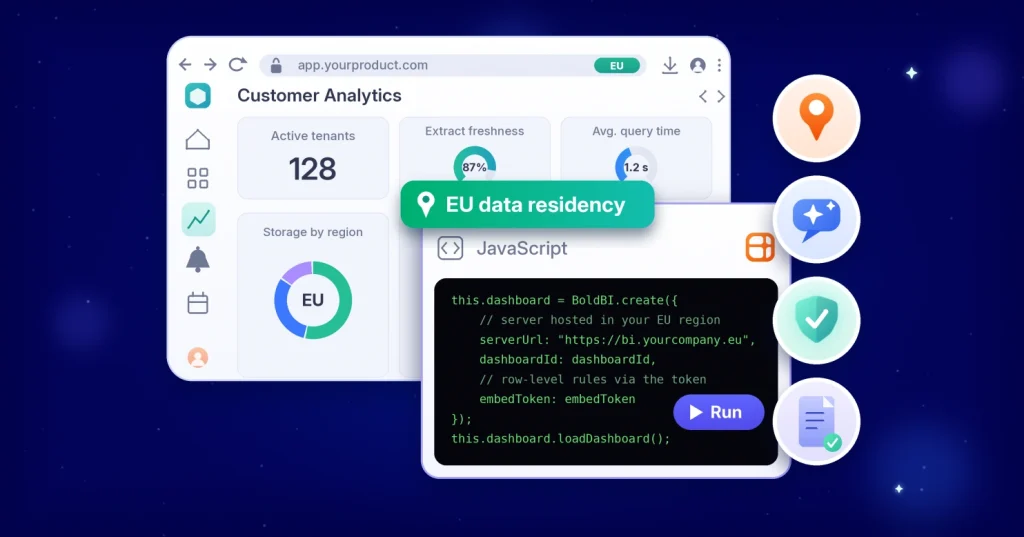
TL;DR: Data residency compliance goes beyond choosing a database region. Organizations must understand where data is stored, processed, transferred, cached, backed up, and accessed across the entire analytics ecosystem. These eight questions help evaluate embedded analytics vendors and identify potential compliance, security, and residency risks.
Introduction
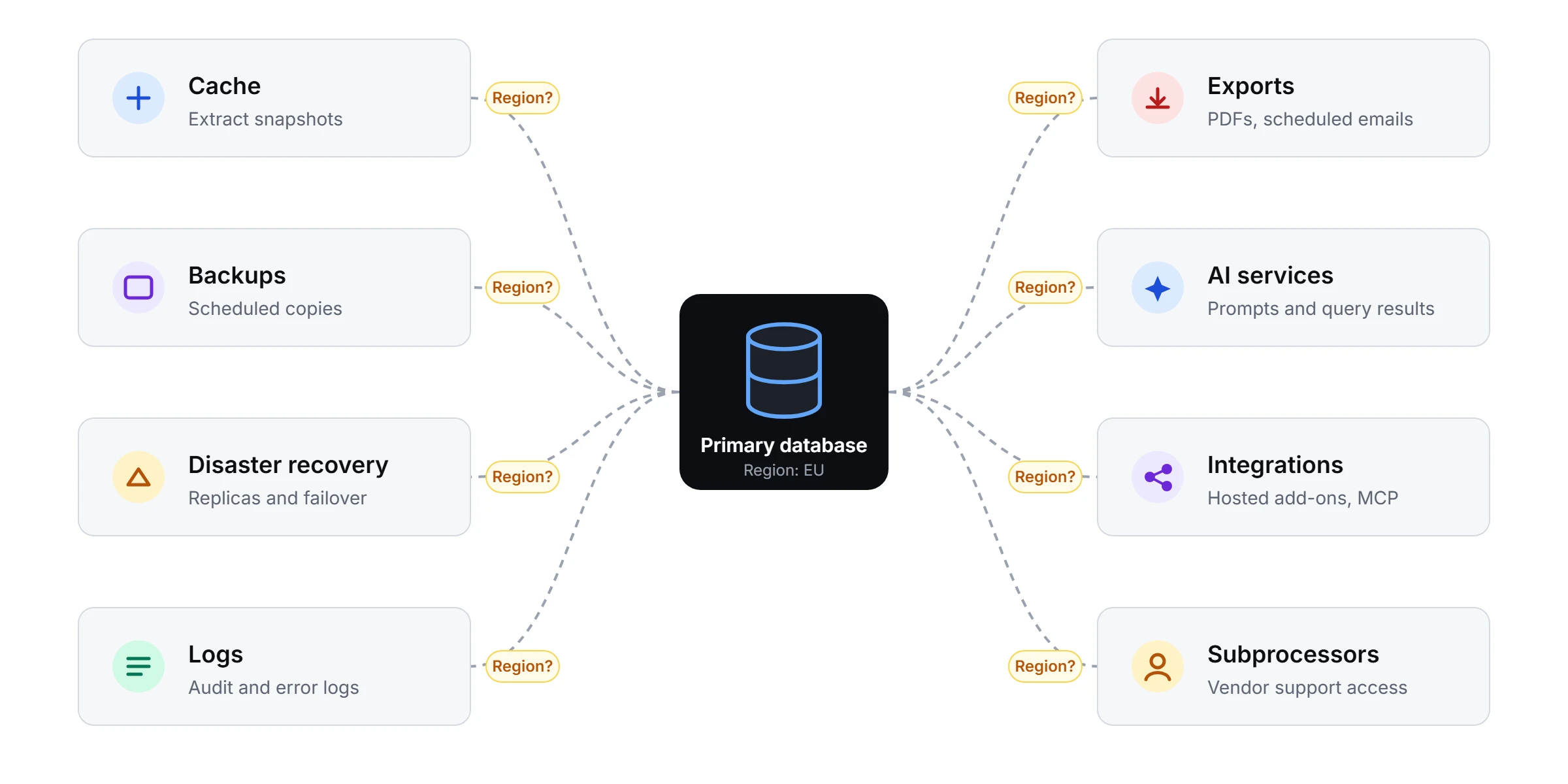
When evaluating data residency compliance, the first question is usually, “Where is the database located?” However, compliance requirements extend far beyond database hosting. Data can also be copied to caches, backups, disaster recovery environments, logs, exports, AI services, and third-party integrations. Each location creates its own residency, governance, and regulatory obligations.
This guide outlines eight important questions security and compliance teams should ask when evaluating embedded analytics vendors. By following every place data is stored, processed, or transferred, organizations can better assess residency risks and choose a deployment model that aligns with their requirements.
What is data residency compliance?
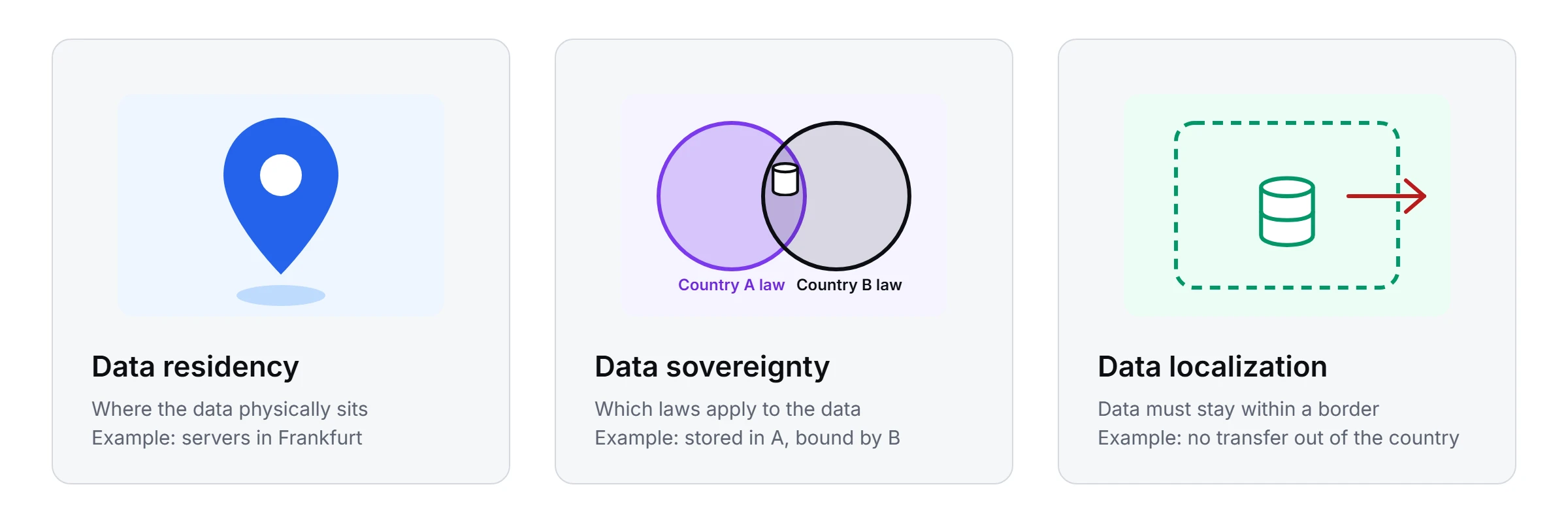
Data residency compliance refers to meeting regulatory, contractual, and organizational requirements that govern where data is stored, processed, transferred, and accessed. While the terms are often used interchangeably, data residency, data sovereignty, and data localization have distinct meanings.
Why embedded analytics makes data residency harder
A standalone BI tool serves your own staff. Embedded analytics serves your customers, inside your product, often across regions. That changes the stakes in two ways.
First, your customers’ data now flows through a third party’s software. Second, each customer may have different residency terms in their contract with you.
Take a hypothetical EU fintech that embeds spending dashboards for business clients in Germany and France. Its contracts promise that client data stays in the EU.
Under the EU’s rules on international data transfers, moving personal data outside the European Economic Area requires a legal mechanism such as an adequacy decision or standard contractual clauses. So every place the analytics layer copies data matters, not just the primary database.
8 questions to ask embedded analytics vendors about data residency
Data residency risks often exist beyond the primary database. These eight questions can help uncover them before they become compliance or security issues.
Where is data stored, cached, and backed up?
Ask whether dashboards query your database live or copy data into an extract. Extracts are faster. But they’re copies, and copies have their own location. Bold BI® supports both: live mode queries the source directly, while extract mode stores optimized snapshots on the Bold BI side. Choose per data source.
Organizations should also ask about backups, disaster recovery environments, database replication, and business continuity plans. Copies created for resilience may be stored in different locations than production systems. For example, an EU fintech that stores production data in the EU would need to understand whether backups, disaster recovery replicas, or failover systems are retained elsewhere.
Good answer: A clear map of every place data is stored, including caches, with the region for each.
Where does the analytics server itself run?
Bold BI’s shared cloud runs in the US region. According to Bold BI’s hosting locations guidance, managed hosting is created in the US by default, but Bold BI can deploy it in another region on request, and costs may vary by region. For EU-only data, that means managed private cloud in an EU region or the on-premises edition. Organizations that need fully air-gapped networks should use the on-premises edition.
Good answer: A named region and a documented option to run in your region or your own environment with the same features.
Where do AI features send data?
AI assistants send prompts, and often data samples or query results, to a language model. Ask which model provider is used, in which region, whether prompts are kept, and whether AI can be switched off per tenant. Bold BI supports bring your own key (BYOK) capabilities, helping organizations maintain greater control over AI-related data flows. The AI provider, processing region and retention policy depend on the model and BYOK configuration you choose.
Good answer: The provider, the region, the retention policy, and clear administrative controls over AI usage.
How are tenants kept apart?
Residency is meaningless if one tenant can see another’s data. Ask how isolation is enforced (row-level rules, separate databases or both) and how it’s tested. In Bold BI, row-level security for embedded dashboards is applied on the server through the embed token. Bold BI supports site-per-tenant setups, and custom attributes can switch the data connection for each tenant when databases share a schema.
Good answer: Server-side enforcement, support for separate databases per tenant, and a repeatable cross-tenant test.
Where do logs, exports, and scheduled emails go?
Audit logs, error logs, PDF exports and scheduled email reports all contain data. Ask where each is stored, how long it’s kept, and who can access it. A dashboard can stay in the EU while its monthly PDF report travels anywhere an email can go. Bold BI includes an audit trail for tracking user activity.
Good answer: Documented locations and retention policies for every log and export type, along with admin controls over scheduling.
Which integrations and support teams sit outside the deployment?
Bold BI’s MCP Server is a hosted service that connects AI clients to Bold BI through APIs. It needs outbound HTTPS, so it won’t work inside a fully air-gapped network. It acts with the permissions of the API key you give it, so use a least-privilege account.
Organizations should also ask about vendor support access and subprocessors. Bold BI maintains a published subprocessor list that identifies the third-party services used to deliver the platform and where those providers operate.
Good answer: A list of every hosted component, the data it touches, and whether it can be disabled.
What independent evidence can you see?
Certifications don’t prove residency. They do show that controls are audited.
Bold BI completes an annual SOC 2 Type 2 audit covering a 12-month period, and customers and prospects can request the report through support or sales. On Bold BI’s hosted platform, data is encrypted with TLS 1.2 in transit and AES-256 at rest.
Also review the vendor’s Data Processing Addendum (DPA). Bold BI’s DPA includes EU data transfer clauses and requires 30 days’ notice before sub-processors are added or replaced. Self-hosted Bold BI Embedded is outside its scope, because the software runs on your own systems.
Good answer: A current report you can review under NDA, not just a badge on a web page.
Can we move the whole stack if our rules change?
Residency rules change. So do customer contracts. The safest vendor is one where moving from cloud to private cloud, or on-premises, is a change of hosting, not a migration project. Bold BI provides cloud, managed private cloud, and on-premises deployment options designed to support a consistent analytics experience across environments.
Good answer: The same features across every hosting option and a documented path between them.
Data residency checklist: how Bold BI answers each question
Use this checklist in vendor evaluations. The last column shows Bold BI’s answer for each question.
| Question | Why it matters | What good looks like | How Bold BI handles it |
| Storage and caching | Copies have their own locations | Map of every store and cache, with regions | Live mode queries the source directly; extract mode stores snapshots on the Bold BI side. Choose per data source. |
| Server location | Decides the primary transfer | Named region or option to run in your own environment | Shared cloud runs in the US region. Managed hosting defaults to the US, with another region on request (costs may vary). On-premises runs in any region, including air-gapped networks. |
| AI data flow | New processor, new region | Provider, region, retention and admin controls | BYOK lets you use your own OpenAI, Azure OpenAI or Anthropic key (Anthropic added in v16.1), so AI traffic runs under your own provider contract. |
| Tenant isolation | Residency needs separation | Server-side rules, per-tenant databases, repeatable tests | Row-level security is applied on the server through the embed token. Site-per-tenant setups are supported, and custom attributes can switch the data connection for each tenant. |
| Logs and exports | Easy to forget | Locations, retention and admin controls | Audit trail tracks user activity. |
| Hosted integrations | Hidden data flows | Inventory of hosted parts and off switches | The MCP server is hosted, needs outbound HTTPS and acts with the permissions assigned to the API key, so it won’t work in air-gapped networks. The sub-processors list is published. |
| Independent evidence | Trust but verify | A current audit report you can read | Annual SOC 2 Type 2 audit covering 12 months, with the report available through sales or support. TLS 1.2 in transit and AES-256 at rest on the hosted platform. Published Data Processing Addendum with 30 days’ notice of sub-processor changes. |
| Portability | Rules and contracts change | Same features across hosting options | Cloud, Managed Private Cloud and On-Premises editions. Bold BI states that every option has the same feature set. |
Conclusion
By asking these eight questions during vendor evaluations, security and compliance teams can identify data residency risks before contracts are signed. A practical approach is to create a complete data-flow map that traces where customer data is stored, processed, transferred, backed up, logged, exported, and accessed. This often reveals compliance gaps that aren’t visible when evaluating database location alone.
Ready to evaluate embedded analytics platforms against your data residency requirements? Start a free trial to explore Bold BI’s embedded analytics capabilities firsthand, or schedule a personalized demo to discuss your data residency, security, and deployment requirements with our team.
Frequently asked questions
-
-
- 1.
Is data residency the same as GDPR compliance?
No. Residency is about where data is stored and processed. GDPR covers much more, including lawful basis, rights and security. Keeping data in the EU can simplify transfers, but it doesn’t make a system compliant on its own. Legal and compliance teams should confirm which regulations, such as GDPR, UK GDPR or HIPAA, apply.
- 2.
Does self-hosting solve data residency?
It solves where the core system runs. You still need to check AI providers, hosted add-ons, email delivery and backups, because each can move data elsewhere.
- 3.
Can one embedded analytics platform serve EU and US customers?
Yes, if it can run in more than one environment. Many SaaS teams run a separate deployment per region and route each tenant to the right one.
- 4.
What should we ask for in writing?
The data flow map, the list of subprocessors and regions, the AI data policy and the audit report. The EDPB’s guide on international transfers explains what a transfer impact assessment should cover.
- 1.
-